I’m wary of nostalgia. After all, nostalgia’s not what it used to be, right?
But here’s me on the Great Britain I miss. I videoed it. So you don’t even have to read anything.
Running time: 4 minutes 45s
I’m wary of nostalgia. After all, nostalgia’s not what it used to be, right?
But here’s me on the Great Britain I miss. I videoed it. So you don’t even have to read anything.
Running time: 4 minutes 45s
There’s an idea with alarming currency which suggests that young people, who are less likely to suffer and die with Covid, should not have their lives “put on hold”, and older and more vulnerable folk should hide away while the young get on and go about their business.
That this idea is still given credence – e.g.BBC’s Nick Robinson put it to the WHO’s Regional Diretor for Europe, Dr Hans Kluge, this morning on Radio 4’s Today Programme – makes me feel sick.
What kind of society needs reminding that we each have a duty to protect our parents, our families, and the wider community?
Because the point isn’t that the young are safe(r); that’s only half the story. The other half is that what they might spread is massively, cataclysmically lethal.
In no other circumstance would we defend lethal behaviour on the basis of the individual’s own comparative safety.
Just as we would not allow drink-driving, even if the drink-driver were safe inside a tank.
In society we forego “freedoms” all the time, particularly those which endanger the lives of others.
We don’t run amok – because cooperation works. It benefits us all.
A week is a long time in a young life. A summer is forever.
But let’s not add to their frustrations by suggesting that restrictions are generationally unfair.
Instead, let’s remind the young that, in a good society, we look out for each other. It’s not something to be indignant or angry about. It’s something to be proud of.
And let’s remind them that, in a good society – hopefully – the young grow old.
Click to listen – running time 5 minutes, 30 seconds.
In his infamous “Sunday Address” on 10th May, Boris Johnson abandoned the Stay at Home message.
As a result, the UK lock-down is rapidly relaxing, and as it does so, we’ll increasingly be going about our business, but with the constant fear of catching the virus.
Trying to get back to normal, but everything – travel, the shops, bumping into friends – laced with anxiety.
Did I just make a mistake? Did I just touch something I shouldn’t have touched? Did that person just breathe on me?
At all costs, we have to avoid catching it. Right?
But, if you think about it, there’s something worse than going out and catching it….

Here’s my story about where I was on the day we gave up Contact Tracing, on 12th March….
About how I did something worse than going out and catching it.
And about the little flashbacks of trauma which I thought were behind me.
Click to listen – running time 5 minutes, 30 seconds.
This audio essay was written and recorded for BBC Radio Four’s Today Programme in the days following the abandonment of the Stay at Home message. It aired, in a slightly different version, on 26 May.
Thanks for listening. Please help me reach more like-minded folk, using the Facebook and Twitter buttons below. Thank you!
For eleven days in March, our government put up its hands and offered a white flag to the virus.
It’s safe to say the virus was unmoved by that surrender.
Since then, it has taken 54,300 British lives.
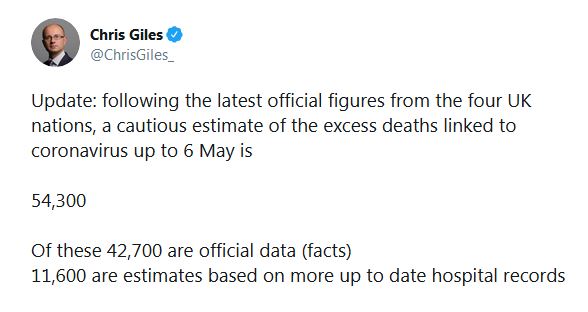
And that’s a “cautious estimate”.
New cases are now rising, at 6,111 per day.
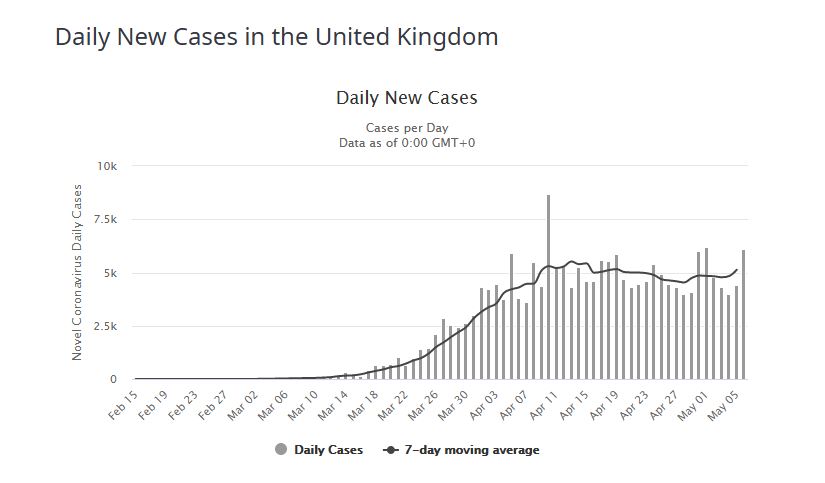
And that’s the official number.
Let’s just say that again. Six thousand, one hundred and eleven new, confirmed cases per day.
And we know that’s only the tip of the iceberg.
As we still don’t have community testing, those 6,100 will be almost exclusively people arriving in a bad way at hospitals. Most cases are never tested.
Remember, too, that not all people who are taken into hospital with Covid-19 test positive. I was one such person.
Covid could have taken me, but I don’t appear in the figures. So even those who end up in hospital aren’t all included in that massive number.
If there are 6,100 known cases, we must conclude that there are tens of thousands more.
Every.
Single.
Day.
By the way, how does our new cases graph compare with other countries?
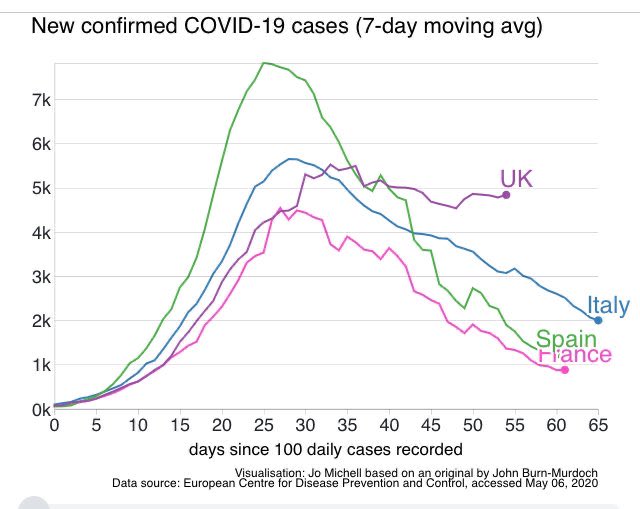
It’s not pretty. But, despite the bleak numbers and the ugly graph, the talk is of “easing lock-down.”
An announcement is promised – curiously, ominously – outside working hours on Sunday.
One extraordinary, baffling, criminally negligent decision in Britain’s maddest-ever March is, if not forgivable, at least mitigated by its context: it was made while deaths totalled a handful.
But now, in Britain’s saddest-ever May, when nightmare numbers have become chilling reality, what possible excuse could there be?
Is our capricious government poised to make another wilfully-deadly decision, come Sunday? Whether or not you are a person of faith, only prayer remains.
Thank you for reading. Please help to reach more like-minded readers by using the Facebook and Twitter share buttons below.