Christmas telly and the Alternative Vote

I’m not going to write some long piece on AV. The airwaves and the internet are full of it.

Most of the coverage, you’ll have noticed, is frighteningly shoddy, patronising, alarmist and cheap – everything we all hate about British politics.

Plus ca change.

But I’m not seeing much on the particular aspect which concerns me, so I’ll have to set it out myself.

It is the part of AV where it works just as its supporters hope it will. It’s also the very part of AV I don’t like.

Here goes. Bear with me. It’s not too nerdy. I promise.

Think of a constituency much like that of my home-town, the Isle of Wight.

Here the natural relative majority is Tory at, say, 45%.

(By “relative” majority, I mean more votes than any other candidate, but not more than half the vote – what the Americans sometimes call a “plurality”. More than 50% would be an “absolute” majority, and in that case AV would not apply.)

LibDems are second on, say, 31%.

Labour are very much third on, say, 20%. Other parties make up the remaining 5%.

Under FPTP, the Tories clearly win. Grrr.

I don’t live on the Isle of Wight anymore. In my day, a vote for Labour was a “wasted” vote and if you were left-minded, you voted Liberal instead. Steve Ross, our Liberal guy, had a strong personal vote, so voting tactically for him made real sense. He was our MP for many years in what I think is “really” a Tory seat.

These days Steve is gone and the seat is Tory-held on a relative (not absolute) majority.

Were I to return to the Island and cast my vote there, AV supporters would seek to console me.

They’d say – vote for Labour first, then LibDem second. If all your Labour colleagues do the same, then your combined vote will hit 51%, and the LibDem will get in. Otherwise your least favourite candidate, the Tory, will win the seat with just 45% under FPTP.

This is exactly the kind of situation in which AV shows its power.

It allows a “coalition of opposition” to the relative-majority candidate.

It delivers an MP with more “support” (51%) than the relative-majority Tory (45%) of the existing system.

And that has to be fairer, right?

Well, happy as I am in this imagined scenario to see the Tories lose, I just don’t think it’s fair.

I don’t think it’s fair that the second choices of me and my Labour mates are conjoined with the LibDem vote to trump the first-choices of the Tory voters.

My Labour candidate came last. His values and views are not widely supported in the local community. So why should his supporters’ second choices count equally against the first choices of the Tory candidate, who, after all, has more support in the community than any other single candidate?

What AV completely fails to take into account is strength of feeling. I really want Labour to win. My second choice might well be LibDem, but I don’t – in anything other than the technical sense – support the LibDems. At the moment, it is fairer to say I despise them.

At the same time, I have to accept that the Tory voters probably really want the Tory candidate to win. These strong preferences ought to count for much more than my very weak and reluctant second “preference” for the LibDem candidate.

They do not. The Tory voter’s strong first preferences are trumped by my weak and reluctant second preferences being lumped together with the support for the LibDem candidate.

In precisely the real-world example where AV might “work”, it delivers results which in my view are unfair.
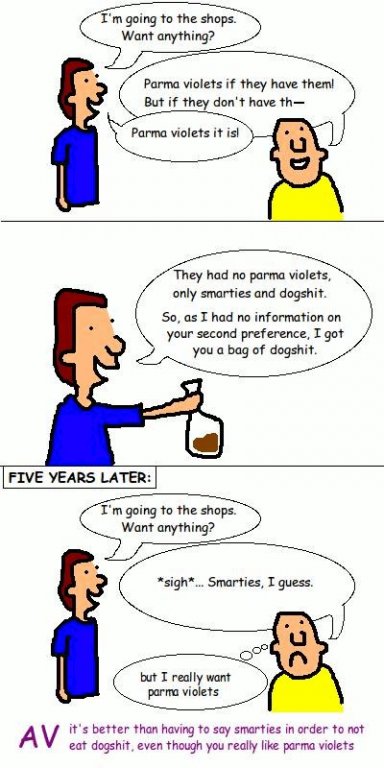
There’s a cartoon going round saying AV is like ranking your preferences for Parma Violets, Smarties or dog shit.

If the shop doesn’t have those Parma Violets, and if you don’t (or can’t) identify Smarties as your second preference, you might just end up with a little stripey bag of dogshit.

Of course, this is a loaded and biased example.

Because Smarties are quite a nice second choice.

What if, like me – and I think like very many others – you want your first choice so much more than your subsequent choice that all the other choices are simply gradations of shit?

If everyone has the choice of sweeties or shit, then a system under which the most people get what they think is a sweetie is the fairest one.

That system is first past the post.

One last example. It’s loaded too, but it’s also a genuine story.

I remember one Christmas with the in-laws. You know the score. Eating and presents done, and all the family – aunts and cousins and all the generations – sits down to watch the TV. It’s a sticky moment: how to decide, in the company of people who come together once every other year, which channel to watch?

On this occasion, most wanted the action film. The youngsters piped up for a kids’ programme. But the old’uns didn’t want the action film or the kids’ programme. They wanted a musical. The line of least contention – everyone’s second choice – was, if I remember rightly, a game show.

It was a proper, polite, wholesome compromise. Some ten minutes in, I was bored out of my tiny mind. I looked around. The kids were bored too. So were the adults. So were the old’uns. Nobody was really watching. Nobody was getting what they wanted.

We had chosen our channel under a kind of impromptu AV. I remember wishing we’d done it on a show of hands: old-fashioned first past the post. At least then we’d have gone for the channel which made the biggest single group of people happy. Instead we were all sitting there politely enduring the compromise nobody wanted.

Strength of feeling matters. First choices matter. That’s why I’m voting No to AV.

Spectator blog illustrates Labour fiscal responsibility

29th March, 2011


The Indie journalist, blogger and tweeter Johann Hari posted an article today about Tory scare-mongering on the UK’s deficit.  (You can see it here.)


Hari calls the scaremongering the biggest lie in British politics.


Peter Hoskin, writing in The Spectator’s online “coffeehouse” has issued a swift rebuffal.  (You can see it here.)


One of Hoskin’s points is that the deficit (if not the debt) is the highest on record.  He produces a chart based on Treasury figures to prove his point.  (You can see it below.)


You may be surprised to know that I really like this chart.


Look at the ten Labour years before the crash in 2008.


See “Brown’s waste” there?  See Labour profligacy there?  See a decade of irresponsible spending there?


Me neither.


Events, dear boy. Events.

23 March, 2011


Harold Macmillan, when asked by a journalist what might blow a government off-course, replied, “Events, dear boy.  Events.”

As an interested, if not entirely innocent, bystander, I am following Opposition Labour’s discourse pretty closely.  It’s not a pretty sight.

Not because of the content – although there is precious little of that.

What worries me is the mood.  It is stuck.

Brave a Labour blog or a Guardian article on Labour’s future and it won’t be long before you come across a solemn sentence starting with the words, “Only when…” which goes on to bemoan the persistence of the party’s ghosts, and forlornly to lament the time required to heal.  Only when the past has been examined, understood, reconciled; only when apology has been issued and accepted; only when the contract between party and public has been redrafted and signed anew; only then will Labour come in, chastened, from the cold. The long march towards rehabilitation, on this gloomy and widely-shared analysis, might not be over in time for 2015.

But I’m not convinced that so much self-flagellation needs to be endured, that so much navel-gazing needs to be indulged in.  I think that with some shows of bold and charismatic leadership, some indications of fresh and intelligent policymaking and above all an injection of energy and confidence, the party could reposition itself in short order.  The requisite self-belief is not yet there, but it could easily come.

Remember how quickly the Tories and LibDems got into bed with each other?  They formed a legislative agenda and modus operandi in the space of a weekend.  Labour can and should aspire to such agility.

Managed properly, the public will not only not resist, but positively welcome the reinvigoration of Labour.  Last May was not so much a turning towards Conservatism as a turning away from some specific Labour problems; the public wanted change, but not so much that it really preferred the alternatives on offer.  Voters left it until the last minute to decide because the broad brush of what Labour stands for was, and is still, what the public wanted.  All parties claim to be progressive – for a reason.

I admit it’s only a hunch (and my old politics tutors would kill me for talking about “the public” as if it were one sentient being) but I have a hunch that that public doesn’t want atonement from Labour.  Last May, yes, it perhaps wanted to punish Labour.  It was uncomfortable with Iraq.  It was uncomfortable with Brown.  It was uncomfortable with the deficit.  But electoral defeat was the punishment, and it was instantaneous.  Look how new members – and old – flocked to the party in the days after the election.  The public can move on very swiftly.  It does not want to see Labour in a protracted period of psychoanalysis.  It wants a responsible, mature, vigorous Opposition.  Capable, if need be, of running the country.

The narrative on the economy must be sorted.  In the interregnum of last year, Labour failed to prevent the Tories branding the party as profligate.  That mud has stuck despite Ed Balls’ spirited start.   Labour now finds itself in the unhappy position of having to consider the old, humiliating strategy of promising to match the Tories’ spending plans in order to shield itself from attacks on the economy.  I’m not convinced it would work this time, or, even if it would work, whether it is the right strategy – given that the Tories’ spending plans are so repellent.  But that’s for a separate discussion.  (In the meantime Labour could recover ground with cleverer and more consistent use of language on all issues but particularly the economy.  This is a perennial problem for the more subtle economics of the left.  The right have this one easy; corner-shop speak is so much easier to sell.  “Maxing out the credit cards,” etc.)

But mostly my contention is that Labour will be ready when it decides to be ready.  And I hope/pray/worry that the day when it needs to be ready could be more imminent than most insiders seem to imagine.  The Coalition is not set in stone.  Libya could change everything.  The referendum could change everything.  Another economic crisis could change everything.  Not in 2015, but in months.

Events, dear boy.  Events.  Labour should stop atoning and start preparing.


Higher Moral Education

15 March, 2011

Today Oxford came out as another university set to charge the maximum £9,000 fees.

If the Tory-led government’s actions were, as they claimed, a) “progressive” and b) not going to put poorer people off applying to university, why does Oxford have to spend 10% of its fee income “protecting access” for the disadvantaged?

Surely the government’s progressive loan repayment scheme has that covered?

I’m joking of course. There was nothing in the government shake-up that corresponds with any decent-person’s definition of “progressive.” The fact that a few graduates may pay a little less, or more slowly, doesn’t make it progressive. If I say water is now ten pounds a bottle, it is no defence that a few people, in certain constrained circumstances, might get it for a couple of quid. I’ve still made water a luxury item.

~ o ~

As a comprehensive schoolboy at Oxford, I was active in the “target schools” programme, encouraging those from state schools to apply to Oxbridge. In my experience the problem was not institutional bias against the state sector, but simply getting the state-sector applications in the first place. So I’m all for access. But I’m not sure I’d have been so keen to pay for the encouragement of others to apply. I’d have wanted every cent of my education fees spent on my education, thanks.

The truth about the government’s macho stance on access is that it will probably amount to nothing. Offa has a tiny staff and limited powers. If the government, driven by fears of the cost of financing higher-than-anticipated tuition fee loans, did give real teeth to Offa, it would be accused of social engineering in a cack-handed and unfair way. Above all, students would NOT see £2700 over three years spent on “broadening participation” as good value for their money.

So I think this element of the reforms will fizzle out in time. I suspect that’ll be fine by the government, because it will have served its purpose – namely to muddy up the debate on fees and to dress up dramatic cuts as moral righteousness. This “moral ingredient” strategy is successfully deployed by the government in many other areas. Don’t be fooled. If this government really valued access to higher education… well, it wouldn’t start from here.