3rd Minghella Film Festival – King of Rome

14 March, 2011


The 3rd Annual Minghella Film Festival closed last night with a June Tabor concert in the unlikely – but wonderful – venue of Freshwater’s Memorial Hall. (June and her collaborator, pianist Huw Warren, needed a Steinway, and the Mem Hall has one, not to mention an established reputation for world-class concerts.)


June has been part of our family soundtrack ever since she recorded Anthony’s songs for the television version of his play, Whale Music, in 1982. It was such a thrill to have her on the Island and performing live, after nearly three decades of knowing her only through her recordings.


She themed her sets around ideas of the sea and our maritime history – appropriate to the Isle of Wight setting, but also to her latest album, Ashore.


It was a wonderful, transporting night. June doesn’t do frills, in music or in presentation. Her concession to image was a smart black Chinese silky jacket with red trim, but she wore it over what might have been her gardening clothes. On each wrist there was a watch, with the face inside rather than out. Her focus is on unadorned purity and simplicity of sound, and in this there is no lack of passion. At her most intense moments, as for example in her haunting solo King of Rome, she clenches her left fist in apparent pain.


Her voice is one of the most distinctive in English folk, resonant in the lower registers but with a capacity for dainty jauntiness when the mood takes her. Her speaking voice is surprising, almost girlish. She has no interest in being cool. She’ll sing daft ditties by William Makepeace Thackeray. Then she’ll take your breath away with a superb, simple, angry rendition of Elvis Costello’s Shipbuilding.


My favourite, King of Rome – I confess I requested it weeks in advance – tells the true story of Charlie, a pigeon racer from the west end of Derby, who sends his bird to Rome in 1913. On the day of the race, a storm blows in and a thousand birds are lost. Everyone tells him he should have known better. All that land and sea! Charlie says: “Yeah, I know – but I had to try. A man can crawl around, or he can learn to fly. And when you live round here, the ground seems awful near…”


That sense of dreams seeming a long way from coming true chimes with our experience of growing up on the Isle of Wight in the 1970s and 1980s. You looked across at Portsmouth and the mainland and you knew the action was somewhere that way, but never here. Youth was one big wait – for the time to go to college and not come back.


[singlepic=296,382,257,right]

It’s not that we didn’t feel pride in the Island. We did. We felt a deep sense of belonging – to a place distinctive, beautiful and unique. You can’t grow up on the Island and not have the images of its cliffs and bays burned into your brain. You can’t spend your formative summers there without carrying forever the ability somehow to smell the warm red of its local brick. Nettles. 1976. Ladybirds. I can close my eyes any day in London and hear the old SRN6 Hovercraft booming across Ryde sands onto the slipway.


But you always knew you’d be going. And that created a forlorn relationship, not just between generations, but also between youth and home. The story, however idyllic, had tragedy built in. The Victorian shelters on the Esplanade, where small dramas of smoking and snogging were played out in grey off-season drizzle, were hardly “ours” any more than they belonged to summer’s “grockles”. Because we were all visitors in the end. Of all the inhaled images of the Island, the most intoxicating are those connected with arrivals and departures.


King of Rome speaks to me because it is about the need to dream and to act on dreams, however small. The possibility, even the likelihood, of being blown off course, swept away and never seen again. And despite that, the need to try. Anyone who grew up on the Island in that period knows that sensation.


When my brother was young, he used to accompany our granny down to the beach at Ryde, where she used to dream of love returning. Her sad story inspired Anthony to write, and to escape. The ground seemed awful near.


As June Tabor paints her picture of lost dreams, the hairs stand up on the back of your neck. You cannot help but wallow in the inexpressible sadness of it all. “Charlie we told you so. Surely by now you’d know – when you’re living in the west end, there ain’t many dreams come true.”


It comes as such a shock, even if you know the song, that suddenly there’s a wing-flash up in the blue; that the bird, after weeks of battling, has somehow made it back. Charlie come outside quick, he’s perched up on your roof! The King of Rome!


[singlepic=297,200,300,left]

It is fitting, then, that the Film Festival inspired by Anthony happens on the Isle of Wight and not anywhere else. It’s where the dreams are formed that matters, not where they are played out. It’s about returning to the perch, coming home, about knowing where you belong.


If you can pin a life of achievement onto one moment, Anthony’s was perhaps Oscar night, 1997, when The English Patient swept the board. This was a film shot mostly, of course, in Rome. And feted five thousand miles away in LA.


And yet it felt like a homecoming. Nobody thought it was odd, least of all us, when he held his trophy aloft and declared, “this is a great day for the Isle of Wight.”


The Naming Of Parts

13th July, 2010

One of my more infantile habits is to namecheck my friends in my scripts.   Almost every character has a name that means something to me, and mostly it’s my way of saying “hi” to someone important to me.  It’s something Anthony used to do, god bless his cotton, so it’s not even original; I am merely carrying on a sentimental family tradition.

Lovely, clever, adorable women are often called Sarah, for reasons you might be able to guess, or Louisa after my daughter (e.g. in Doc Martin), or Jane after our college friend who is one of the softest, kindest and best people I know.  I make that classic assumption that all Janes are like the Jane I know.  (Not that I know only one Jane, but this Jane is my main Jane, if you know what I mean.)

It’s very hard to break out of it.  And the flip-side is that a badly-named character can throw you off course when you’re writing.   Some characters can or can’t do things purely in virtue of the name they’ve been given.  For that reason I will sometimes stop and think for – well, too long – before I christen a character. 

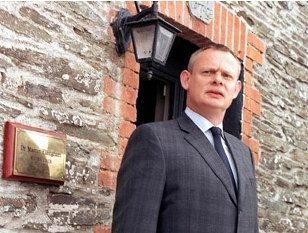
When I wanted Martin Clunes’ character in Doc Martin to be more real, more ‘mine’, more like me or my argumentative son, I gave him my surname in anagram form – Ellingham instead of Minghella.


Sometimes it backfires.  I have one friend who has noticed that his name is often given to unpleasant characters.  It’s true, but no reflection on him; it’s just that his name fits jerks better.  Try explaining that to a disgruntled old school chum.

I named the Sheriff of Nottingham “Vaizey,” and only after the deed was done did I remember that there had been a Vaizey at my college in Oxford.  We weren’t mates, so my subconscious had probably chosen the name judiciously; or rather, injudiciously: we’ve had some email exchanges lately, in which he revealed that he noticed, and that he drafted a (presumably stern) letter to me, but decided not to send it.  I don’t think any writer wants to receive a letter from a barrister about the use of his name.  Be especially careful if that barrister is going to go on to become the Culture Secretary.  For that reason alone, dear readers, do not try this at home.

Even if you don’t take someone’s name in vain, the fact that your stories are personalised in this way sets people looking.  I have a number of friends who think Doc Martin is based on them; one is a doctor called Martin, so you can understand that – except that the show was called Doc Martin before I was hired.  Others see a trait or a habit or a hobby in a character, or a turn of phrase, and assume I’m ribbing them.   I have found it useless to deny it, even when sometimes several people take the same evidence as proof that a character “really is” them. 

In the end of course, all writing is – and should be –  informed by experience, and so everybody and every thing springs from some sort of reality – which is why it’s important that us writer-types get out more often.

P.S. Some names are safe even from my childish pen.  Dante, my son, has a name it is hard to drop casually into a drama.  Gioia and Loretta, my sisters, are probably safe at least until I get somewhere with my film about Puccini.  But even in an Italian setting, Edana, my middle sister, is going to have little to worry about.  Edana is not an Italian name.  It is not really a name at all.  Our parents invented it.  They just liked the sound of it, so that’s why Edana is Edana.

But, dear Edana, like it or not, you shall go to the namecheck ball, and you can’t blame me for it.  You’re in The Archers!   You’re young, you’re fit, you’re a fine figure of a girl.  The mere sight of you was enough to make heartbroken Pip know she was home, where she belonged.  You are, my darling sister, a prize heifer.


Movie: Please Give

4 July, 2010


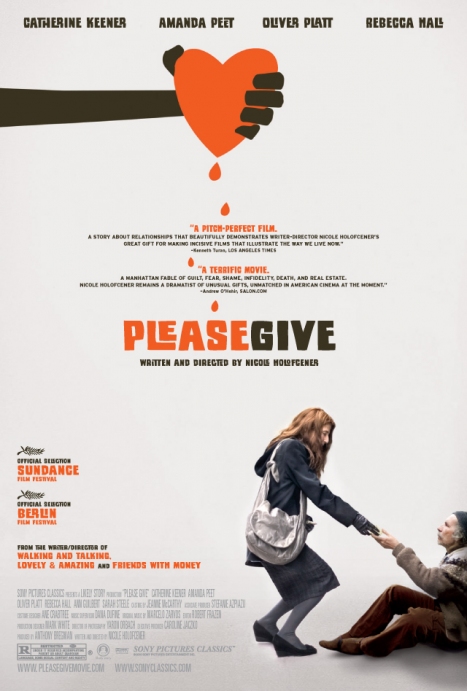
Nicole Holofcener’s slice-of-life movie, set in affluent NYC, is a real gem.  She writes terrific dialogue – moving deftly between comedy and pathos – and elicits very fine performances from her cast (Catherine Keener, Rebecca Hall and others, all marvellous).  


If CK Williams had been a film-maker….  In fact, it also made me think of my brother Anthony, because of its delight in well-observed, comic dialogue, its interest in contemporary relationships and its analysis of the guilt that goes with affluence.  In some ways it could be the movie version of Anthony’s wonderful radio play, Cigarettes & Chocolate.  They’re both about a middle-class woman in crisis, trying to understand inequality – and the impact of that central collapse on those around her.


Another movie I like in this terrain is the Italian film Caos Calma (aka Quiet Chaos, 2008), based on the lovely book by Sandro Veronesi, in which a bereaved man stops going to work….


There you go.  Hot tips.


Notes to AM – movie moments.

26 April, 2010


Dear Ant,


Awarded the prizes in your name at the Hull Glimmer Short Film Festival this weekend.


The Anthony Minghella International Short Film Prize went to a mad, brilliant piece by Ramin Bahrani called Plastic Bag.  The film is narrated with great and understated wit by Werner Herzog.  It’s about the tragic emotions of a plastic bag who, having been used and discarded, is blown in the wind, searching as he goes for his ‘maker’ and for the meaning of life.  The ‘movie moment’ for me comes when he meets a red bag, the breeze takes them and they dance together like kites in the sky.  Isn’t she beautiful? he asks, excitedly, hilariously.


It’s a cruelly short-lived love story, alas.


AM writing in Hull, 1970s

Last time I was in Hull, October half-term in 1978 or so, you met me at the station.  I’d come up on my own from the Island, and managed the transfer between Waterloo and Kings Cross and was feeling pretty pleased with my twelve year-old self.  Different times.  You hugged me and asked me if Mum had given me any money for my keep.  Knowing full-well she’d given me a fiver.


So this weekend, I was braced for the emotion of recollection and loss.  I thought the station would be more or less the same and that I’d remember you standing there, waiting for me, my incredible brother.  Your smile, a blend of warmth and knowing.  Your gift for connection.  Your ability to see into souls.


But the station wasn’t the same.  Nothing to remind me of the visits of my boyhood.  Not even a whiff of recollection.  There’s a steel-and-glass shopping centre right next to the station, with a Tesco extra if you please.  And the air is different.  On Princes Quay, an alfresco cafe serves coffee in a daft two-cup arrangement.  Hull has acquired fancy northern ways.


(True, I didn’t have time to do the other stuff, the stuff that would surely have conjured you up and conjured up the tears.   I didn’t see Norman Staveley – your accountant and friend.  I didn’t visit your colleague Tony Meech in the University drama department – the place where you metamorphosed from quasi-delinquent schoolboy into the artist as a young man.  The place where you went in a slug, but emerged a butterfly.  There’s a studio there now with your name on it.  I didn’t go to your old house at 168 Park Avenue, where there’s a blue plaque and even a tree sculpture in your honour.)


So my bracing was unnecessary.  I didn’t bump into you on a single street corner.  There was no pain of vivid memory.  None of those sudden slap-in-the-face flashbacks which characterise grief.


The opposite, I’m afraid.


The truth is that Hull has moved on.  You’re just an echo now.   At the awards ceremony, the young film-makers who listened to my thumbnail sketch of your time at Hull weren’t – I think I’m right in saying – hugely interested.  They have their own careers to think of, and – except as a name on a prize – you can’t help them anymore.  Don’t be offended.  It’s just the order of things.  Larkin too, I noticed, is reduced to a logo these days: inch thick specs.  


The power and pulse of your charm and talent  – it used to electrify rooms.   There were fights, almost, to be near you.   Now all of that seems so ephemeral.


A brief dance in the wind.  A love story, cruelly short-lived.