Crowding Out: The nub of the NotMeGov credo

14th July, 2010

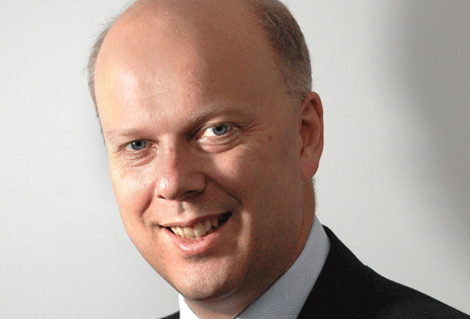
Interesting to hear the Work and Pensions minister, Chris Grayling, on Radio 5 Live this morning, sympathising with the unemployed.  He recognised things were tough out there and would be tougher, but he reckoned the private sector would, eventually, provide.

This is the absolute nub of the ConDem experiment, the sharp end of the debate about small versus big state.

The old Tory idea (which is what it is) that the state needs to be small in order for the private sector to thrive is based on two thoughts.

First, business doesn’t like bureaucracy.  Sausages have to be a certain shape!  Europe is bossing us about!  Get rid of this red tape!  Then business can thrive.  That’s a crowd-pleaser.   Not so much an economic argument, more a libertarian reflex.

The second thought is the posh one.  It’s the idea that when the state spends, it borrows money.  As it borrows “more and more” it needs to pay a better rate for its money, i.e. interest rates rise.  That affects mortgages and, crucially, the price of money for business.  Business cannot borrow, cannot invest, cannot hire.  This is known as the crowding out argument.

(Hard-line subscribers even call private sector jobs “real” to distinguish them from [presumably unreal] public sector jobs; I noticed Chris Grayling slipping in a “real”, psychologically to upgrade these new jobs he’s hoping will materialise.   Honestly!   Perhaps we should all go round town with a badge to show whether we’re doing a real job or a phoney, state-sponsored one.)

When asked where the vital new jobs would come from, Chris Grayling replied, “I’m not a crystal ball-gazer.”  He doesn’t know, and you can’t help feeling he’s happy with that; perhaps because the ‘real’ jobs are somehow only real when the minister for jobs has had nothing to do with creating them.  Not knowing becomes almost a badge of honour – yet another articulation of the government’s deft, cheerful retreat from responsibility for anything or anyone.

Chris Grayling may not know where the jobs are coming from, but he has listened to reliable institutions like our friend the OBR and they say it’ll be all right.  He went on to explain the crowding out argument.  And that, pretty much was that.  It’s hard for interviewers to argue against the crowding out argument.  It’s capital E economics and it shuts people up.

But you don’t have to know your monetarism from your Keynesianism to know that we’re running a massive deficit in this country.  And yet interest rates are virtually zero.  Whatever is holding business back, it can’t be the rate of interest.

What really motivates business to invest is the whiff of profit.  Sure, costs matter, and the cost of money matters.  But it couldn’t be lower.  What matters is sales.  Are punters going to buy our product?  Will they be spending?  Will they have pounds in their pockets?

If punters are unemployed, or fiscally squeezed, or saving for a rainy day in the light of dire government warnings about broken Britain, they aren’t going to buy your product.  No point investing, no matter how cheaply you can borrow money.  If government, at the same time, is slashing its spending like it has never slashed before, there’ll be no public sector demand either.  Time, you might decide, to pack up and go home.

That, in essence, is the debate.  Of course it is much more sophisticated than that, and I don’t profess to be an economist.  But I do know that the private sector is about people like you and me who spot the chance to make a buck  – who see a market they can sell into.  We are driven by opportunity.  We do not notice that the price of money is low and then ask ourselves what business we might want to set up in order to take advantage of those nice low interest rates.

Forget the intellectual argument and ask yourself if you would invest in a new business in the UK at the moment.  I know I would not.

I doubt Chris Grayling would either; when I listened to him trotting out the crowding out argument today, I didn’t think for a minute that he believed it.

The only crowding out that’s going on these days is the crowding out of reason and the shameless, cynical, oh-so-slick crowding out of responsibility.


The Naming Of Parts

13th July, 2010

One of my more infantile habits is to namecheck my friends in my scripts.   Almost every character has a name that means something to me, and mostly it’s my way of saying “hi” to someone important to me.  It’s something Anthony used to do, god bless his cotton, so it’s not even original; I am merely carrying on a sentimental family tradition.

Lovely, clever, adorable women are often called Sarah, for reasons you might be able to guess, or Louisa after my daughter (e.g. in Doc Martin), or Jane after our college friend who is one of the softest, kindest and best people I know.  I make that classic assumption that all Janes are like the Jane I know.  (Not that I know only one Jane, but this Jane is my main Jane, if you know what I mean.)

It’s very hard to break out of it.  And the flip-side is that a badly-named character can throw you off course when you’re writing.   Some characters can or can’t do things purely in virtue of the name they’ve been given.  For that reason I will sometimes stop and think for – well, too long – before I christen a character. 

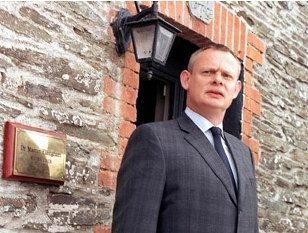
When I wanted Martin Clunes’ character in Doc Martin to be more real, more ‘mine’, more like me or my argumentative son, I gave him my surname in anagram form – Ellingham instead of Minghella.


Sometimes it backfires.  I have one friend who has noticed that his name is often given to unpleasant characters.  It’s true, but no reflection on him; it’s just that his name fits jerks better.  Try explaining that to a disgruntled old school chum.

I named the Sheriff of Nottingham “Vaizey,” and only after the deed was done did I remember that there had been a Vaizey at my college in Oxford.  We weren’t mates, so my subconscious had probably chosen the name judiciously; or rather, injudiciously: we’ve had some email exchanges lately, in which he revealed that he noticed, and that he drafted a (presumably stern) letter to me, but decided not to send it.  I don’t think any writer wants to receive a letter from a barrister about the use of his name.  Be especially careful if that barrister is going to go on to become the Culture Secretary.  For that reason alone, dear readers, do not try this at home.

Even if you don’t take someone’s name in vain, the fact that your stories are personalised in this way sets people looking.  I have a number of friends who think Doc Martin is based on them; one is a doctor called Martin, so you can understand that – except that the show was called Doc Martin before I was hired.  Others see a trait or a habit or a hobby in a character, or a turn of phrase, and assume I’m ribbing them.   I have found it useless to deny it, even when sometimes several people take the same evidence as proof that a character “really is” them. 

In the end of course, all writing is – and should be –  informed by experience, and so everybody and every thing springs from some sort of reality – which is why it’s important that us writer-types get out more often.

P.S. Some names are safe even from my childish pen.  Dante, my son, has a name it is hard to drop casually into a drama.  Gioia and Loretta, my sisters, are probably safe at least until I get somewhere with my film about Puccini.  But even in an Italian setting, Edana, my middle sister, is going to have little to worry about.  Edana is not an Italian name.  It is not really a name at all.  Our parents invented it.  They just liked the sound of it, so that’s why Edana is Edana.

But, dear Edana, like it or not, you shall go to the namecheck ball, and you can’t blame me for it.  You’re in The Archers!   You’re young, you’re fit, you’re a fine figure of a girl.  The mere sight of you was enough to make heartbroken Pip know she was home, where she belonged.  You are, my darling sister, a prize heifer.


The Things We Could Do

13th July, 2010


China’s high speed trains cruise quietly, steady as a rock, at speeds of 380 kph.


Five years ago, China had not a single mile of high speed rail track.


Today, it has more than the whole of Europe.


Next year, it will have more high speed track than the rest of the world put together.


While China races ahead, full of possibility, aspiration, the future, our thoughts turn to what we can’t do.


Investments we’re too mean to make, retirements we do not want to fund, schools we don’t want to build, scalebacks, cutbacks, clawbacks.


Ambition is thwarted, artistry is squandered, skills are sacrificed at the altar of punitive, mean-spirited ideology.  We are, as the government would have us believe, bankrupt – but not so much financially as emotionally, intellectually.


It’s not just that we need a strategy for growth – and boy, do we need that – it’s that we need a growth of strategy.


Where is the vision for our country?  Where is the inspiration?  What do we have, who do we look to, to rekindle our collective pride, to galvanise our collective efforts, to set the national heart beating?  We are a nation in need of a life coach, in need of affirmation, in need of belief, in need of an idea.


Talk us up, remind us what we can do, take us on a journey, open our eyes, excite us.


Oh, the track we could build.


ConDemNation: Under Hypnosis

12th July, 2010


Sir Alan Budd recently announced his intention to step down as interim boss of the Office for Budget Responsibility.  Labour howled its derision – suggesting Budd’s resignation reflects internal tension; the Treasury did not allow him the independence that was hailed from the Coalition rooftops.


But we’re assured that that’s not the problem.  There is no problem.  He was only ever a temporary chief, and he came magnanimously out of retirement to set the office up; now he’s going back into retirement, as planned.


So we’re told, and the BBC’s Stephanie Flanders believes it, so who am I to question it?   It is certainly true that this was only ever a three-month contract.  But I will say this, two months ago Sir Alan Budd declared the new appointment was “the most exciting challenge of [his] professional life.”


Never mind the leader, there are some questions we can legitimately ask of the OBR itself.  If it is genuinely independent – and that was the point of creating it – why is it housed inside the Treasury?   Why are its members appointed by the Chancellor?  Why do they report directly to the Chancellor? 


The Treasury is trying to tell us the OBR is independent, but that it needs to be privy to ‘budget secrets’, and therefore it must have ‘a close working relationship’ with the Treasury.


It’s independence, then, but not as we know it.


Presumably it’s the same independence that prompted the OBR to rush out revised employment figures minutes before Prime Minister’s Questions so that Cameron had some ammunition in his back pocket with which to defend Harriet Harman’s attacks on the job losses.  Poor Harman was left flapping in the wind, armed only with the figures produced by the OBR the day before; she might have been forgiven for thinking an independent OBR would have tipped her off in the same way as it tipped off Cameron, but no.  And we all might have been forgiven for thinking that an independent OBR might have produced comparative figures on a like-for-like basis, but (as it now turns out) no.


A friend of mine in finance says that’s just politics.   Labour hid the numbers from the Opposition when it was in power; I should only expect the same of the ConDems.  But the economy is now the issue of our times, and the independence of the OBR is a key element of the Coalition’s justification for its choices. 


They repeatedly say their cuts are “unavoidable” and that the independent OBR backs them up.  On 7 June, David Cameron said  the OBR would “show the scale of the problem we are in today”.  (It didn’t really, as I have commented, but that didn’t stop Cameron claiming that it did.)  The narrative is all.  There’s an almighty mess, the narrative goes, and if it’s anyone’s fault, it’s not ours – it’s Labour’s.


For instance, the Education Secretary, Michael Gove, has cancelled 700 school building programmes.   He may be sorry about having issued erroneous lists of the damned, but for the the decision itself, he is unapologetic.

“You’re right, there are some buildings which are in a shocking state, and I wish that we could invest in improving them, but the reason that we can’t is because the Labour government… Ed, Alistair Darling and Gordon Brown left us in this dreadful position….  This is Labour’s legacy….We are the people clearing up the mess…”  (BBC Newsnight)


The mystery is that we are buying the narrative.  We aren’t complaining.  We aren’t rioting in the street.  The British people and our political pundits are in a weird post-General Election funk; licking our World Cup wounds, still hungover from the will he, won’t he? of Wimbledon.   We’re in a coma.   We’re in Ashes to Ashes except that the 1980s and the 2010s are starting to look horribly similar.   While in this state, dear friends, do not drink, drive, or operate machinery.


The plain truth about the cuts is that they are too hard, too fast.  They are going to cause serious short-term pain.  And if the breadwinner in your house loses his or her job, or your school is one of those that’s falling down around your ears, that’s real short-term pain – with long-term consequences.  Lost skills can be lost to the economy forever; broken dreams can throw an individual off-course for a lifetime.  Real lives are not political footballs.  The Class of 2010 is buggered before it even brings its books home from university, because the Class of 2009 is still looking for work.  There are now 70 applicants for every graduate vacancy.


But even if you think some short-term ruining of lives might be worth it, the long-term gain is not going to happen.  The economy will contract, and the OBR’s forecast growth will not materialise.  Why?  Because the government has bailed out of the UK, shouting “the ship has sunk and it’s Labour’s fault”.  Yet it hopes private enterprise will jump on board, attracted by – what?  Lower rates of corporation tax?  Would you hope to make a profit selling in this market?    Lower tax on profits – which is what CT is – doesn’t help you if there are no profits in the first place.  Private enterprise looks to government for stability and security before it invests.  I don’t think I’ve heard, in my lifetime, a government so negative about its own economy.  (My finance friend assures me this is just the management of political expectation; trouble is, the private sector will be listening too.)


When the economy contracts, tax receipts will automatically fall.  Outgoings on dole and benefits will automatically rise, no matter how mean-spirited the regime, as hundreds of thousands lose their jobs.  Less income for the government, and more expenditure.   That means a bigger deficit.   The “unavoidable” choices of this government are just going to make everything worse.


Who says the cuts are too hard and too fast?  Well, obviously Labour, but then they would, wouldn’t they? 


But then what about the world’s largest bond house, Pimco?  (Don’t forget it was supposed to be the markets who were going to destroy us if we didn’t make these “unavoidable” cuts.)

“There are parts of Europe where austerity wasn’t called for immediately,” Scott Mather, Pimco’s head of global portfolio management, said, using the UK and Germany as examples.

He said a double-dip recession in Europe was a “growing risk” and maintained that Pimco’s “underweight position” on both the pound and the euro was justified.  (Telegraph, 2 July 2010)


What about the CBI?  (Don’t forget, the CBI is the donkey that hee-haws dutifully every time the Tories flick their whip.)

The CBI said of the recent additional emergency cuts the move was “disappointing” and called on George Osborne to give capital spending a higher profile in the second half of the parliament.

“Capital investment is crucial to driving the economy forward and the government needs to make sure we get back to the long-run average of 2.25% of national income as soon as possible.”  (Guardian, 4 July 2010)


What about the nation’s Finance Directors, 40% of whom are now fearing a double-dip recession?


What about the CIPD predicting 3m unemployed by the end of the year?


What about the Chartered Institute of Purchasing & Supply?  Their latest services survey shows that business expectations dropped to a 15-month low in the single biggest month-on-month fall ever recorded.


Does any of this sound to you like a world you’d want to invest in?  Would you buy shares in UK plc with these guys on the board?


I thought not.  So, back to the OBR: I’m confused by its forecasts.


The OBR is still predicting overall employment growth despite the dramatic reductions in the public sector.  This means the private sector will have to grow not just well, but like it has never grown before.  For the OBR to be right, the private sector will have to generate two million jobs in the next five years – an unprecedented number.


Go figure.  Or, like Sir Alan Budd, go retire.


The OBR’s credibility is in pieces, and with it the credibilty of the ConDems’ economic position.  The economic innocence the ConDems tout round town is disingenuous.  But it doesn’t seem to matter.   This is a government running a sweet line in “not me, guv” and, so far, getting away with it.  


Nor does it matter who runs the OBR next, because the thing is a misnomer.  It exists not to create responsibility, but to enable the Coalition – by appealing to ‘independent’ figures – to shirk it.   It is the Office for Blame Reduction, an instrument of hypnotic induction.   Under the guise of innocent cleaners, sweeping up an inherited mess, the ConDems are dismantling the welfare state, conducting a rapacious assault on the nation, all for the sake of some ideological small-state credo.


If – or rather, when – it doesn’t work, that’ll be some Other Bugger’s Responsibility.