The Prime Minister’s (alternative) Speech

Good evening.

It is with sorrow and regret that I must announce that my Government’s efforts to control the spread of Coronavirus have failed.

Confirmed new cases are now running at above 20,000 per day, and deaths are averaging 240 per day. R is above 1 throughout the country, meaning the virus is not controlled, and in London the R number is close to 3.

When it comes to patients in hospital with the virus, we are just one doubling away from the peak of the first wave of the virus. Many hospitals will be overrun in two to three weeks, and it is already too late to stop that.

I must level with the British people. It is also too late to stop thousands, even tens of thousands of deaths arising from current infections. I am sorry.

I should have acted sooner. I was advised by SAGE, the government’s own scientists, to institute a limited lockdown on September 21st. I did not follow that advice, choosing instead the so-called “Rule of 6” which we now know had no effect on the spread of the virus.

Influenced by libertarians in my own circle, by a few questionable scientists outside of the mainstream, and by disruptive members of my parliamentary party, I attempted to respond to the spread of the virus with a targeted, or tiered, approach. This approach, apart from causing confusion with a proliferation of rules which have been hard to follow and understand, while seeming contradictory and unfair, has also failed to constrain the virus. I apologise.

Furthermore, those parts of the country in the lowest tier of risk may have been given false confidence, given that R was above one in those areas too, and we now see an effect of “levelling up” with the rest of the country. The targeted approach has not worked, and was inappropriate given the national picture. Again, I apologise.

I now announce a 4-week lockdown in which we as a country must work together to hit the R number hard, and achieve a manageable level of new cases, at around 3,000 per day or fewer. We must therefore reduce the R number to 0.6, which means a lockdown including schools and universities. Nobody wants to do this, but if we kept educational establishments open, reducing R to only 0.85, we would need to lock down for 5 extra weeks to achieve the same level of daily infections. The additional time and cost of this would present an additional burden to our communities and our economy, and entail a further 300,000 infections, according to calculations published yesterday by Independent SAGE.

It has been pointed out that lockdowns do not eradicate the virus. But they do buy time. That time should be used to prepare for life when measures are relaxed. At present, in the absence of vaccine, our best hope of controlling the virus, once infections are running at a manageable rate, is Test and Trace. We need a functioning Test and Trace system if we are to live, as some have phrased it, “alongside the virus” – allowing us to find and isolate outbreaks with speed and precision. I admit that our existing system, for which we all had such high hopes, has failed. I placed too much trust in individuals, including Dido Harding, and in the private sector, and together they have undeniably let the country down.

Therefore I am announcing a return to a genuinely NHS-led public health approach, to be properly resourced and supported, and only when this new system is in place and working, will our lockdown be relaxed.

When that relaxation comes, it will be phased and evidence-based. There will be no more macho-posturing or suggestions that it is an Englishman’s duty to “eat out to help out”, or risk his own health, and risk fuelling the spread of the virus, by returning to offices which are not proven safe, via public transport which is not proven safe. Nor will we be gung-ho about safety and infection risk in schools and particularly universities, because we now know that infections there can spread to the wider population and cause further surges, illness and death.

There are many more mistakes which we have made. Because of them, many thousands of our people will die before their time. I can only apologise and endeavour to make sounder decisions, sooner. I make that promise now.

Further, I repeat a promise I made on Monday, 27th April, when, after my brush with the brink at the hands of Covid, I said:

“I want to serve notice now that these decisions will be taken with the maximum possible transparency. And I want to share all our working, our thinking, my thinking, with you, the British people.”

I did not keep that promise. The Government massaged figures, and hid the details of contracts given out to friendly firms, sometimes with little or no public benefit. Sometimes these contracts have involved the wasting of extraordinary sums of public money. I apologise. The Government did not even keep up briefings of the Coronavirus situation, making it harder for people to find information, and introducing an entirely false sense of public safety. I now announce that daily Coronavirus briefings will resume; they will be as factual and apolitical as possible, and in particular, given that some patients die after a battle with Covid which lasts more than 28 days, the headline death toll will be honestly accounted.

Finally, a word on unity. It has, I admit, suited the Government from time to time to allow, or even encourage, febrile arguments in the public domain. This debate has relieved pressure on me and my Cabinet by bringing confusion and disagreement to a situation which badly needed clarity and unity. There have been very grave consequences in terms of compliance with, and faith in, our measures to combat Covid. I am sorry.

Insofar as the arguments turn on the so-called “balance” between the economic cost of lockdowns, and the human cost of failing to lockdown, I am here to tell you that that distinction is bogus. Countries with the most effective, and toughest anti-Covid measures, have fared the best economically. The best economic measures are the best anti-Covid measures. Full stop.

The virus presents a challenge to the individualist ideology which I usually espouse. Because with a virus, it is not enough for an individual to judge the risk to himself. The risks we take are not privately borne, but publicly shared. We each have a responsibility to each other, and that means we must decide on a joint, collaborative plan. In short we must work together, to protect each other. Government and leadership are therefore key, and I commit my government to a new relationship with you, the British people. A relationship of openness, transparency and responsibility. If those qualities have not exactly been “my style” to date, it is never too late to change. Our lives, it is now clear, depend upon it.


Good night.


Common Sense Kills

There is an idea that you can’t do in the UK what, for example, the Chinese government has done, in strictly enforcing Coronavirus measures.

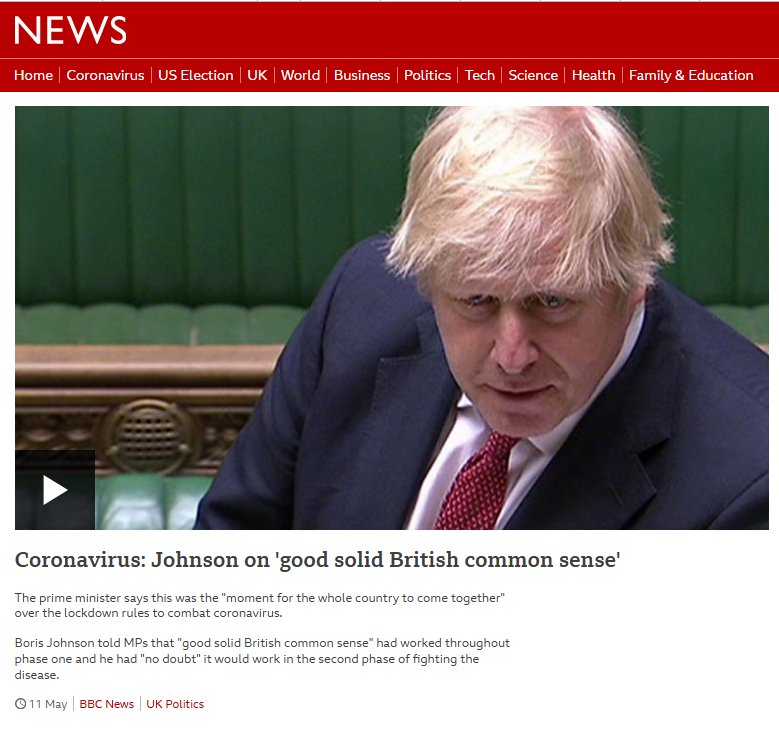
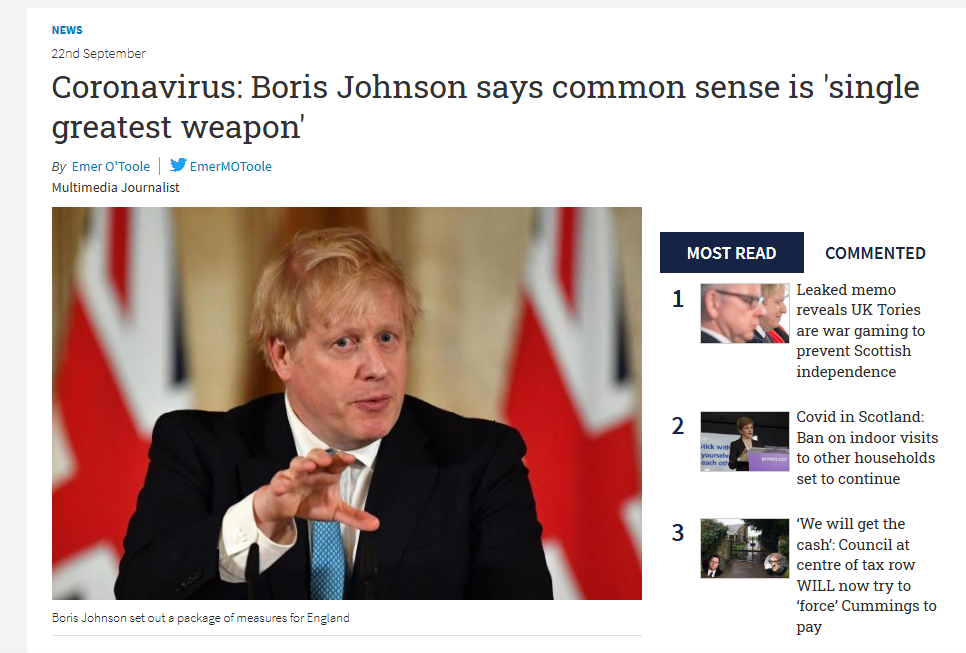
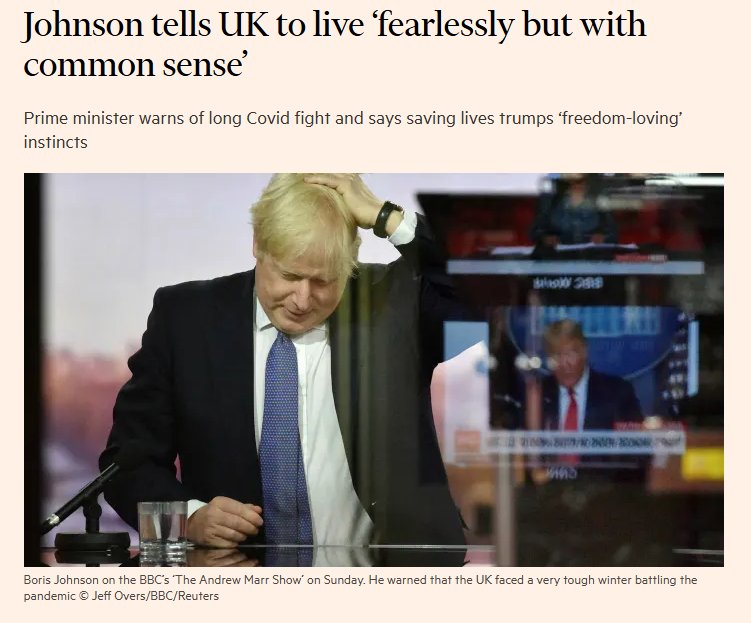
Mr Johnson would have us believe the problem is we are “freedom-loving”. We are not the sort to be coerced. You don’t force people like the Brits to comply, and if you tried, it wouldn’t work. Instead, his government frequently speaks of, and to, our “good, solid common sense”, suggesting that as individuals – inherently decent, inherently sensible, and fiercely independent – we will just “do the right thing”.

“It makes tackling the virus trickier than in other countries,” seems to be the thought, “but, in the end, Brits know best.”

There’s a little truth in this. But much harm.

Of course we need individuals to take responsibility. We can’t police everyone. We really aren’t China. And of course we need individuals to believe in the rules by which we hope they might abide. We need what they call “buy-in”.

But for buy-in to work, several other elements are required:

– Information. People need to understand what it is that, collectively, we are up against. There are now no daily briefings. If you want detail on the daily stats, you have to go hunting for them on the internet.

– Clear rules. A product of the piecemeal, targeted approach, and changing conditions, is an almost total loss of clarity. Even the prime minister doesn’t know what rules he is imposing – as evidenced by a recent embarrassing interview – and the rest of us are implored to enter our postcodes, somewhere on the internet, to find out. You want rules? You have to go hunting for them on the internet.

– Fair rules. Targeted rules still have to select large areas. The only way to avoid that is Test Trace and Isolate, which we do not have because, bluntly, the government tried to get the private sector to deliver it. That failure is of epic proportions, but not for this discussion. When whole areas are selected, inevitably some parts will be worse-affected than others, and feel hard done by. When people feel unfairly treated, they will feel that the rules don’t really apply to them, and feel less compunction in breaking them. In this respect, and in the absence of Test Trace and Isolate, the targeted approach is unhelpful.

– Credibility. The rules need to be believed and believable. That is to say, firstly, Government must appear to believe them. The mixed messages from Government – Eat Out To Help Out contrasting, for example, with exhortations to avoid “minglin'” – are myriad and mercurial. Libertarian voices in the Conservative Party are still pushing forms of “let the virus rip” (aka “herd immunity”) and the overall impression is that the Government cannot, and maybe even should not, get a grip on Coronavirus. This is not a good context within which to hope that measures, often challenging and costly, will be taken seriously.

Secondly, the rules must appear to make sense; to have a chance of success; to be founded on evidence; and to be “following the science”. The public is woefully uninformed when it comes to the evidence. There are no daily briefings. When there were, they were very political. There is good information, freely available – for example from Indie SAGE – but (guess what?) if you want it, you have to go hunting for it on the internet. The advice of SAGE to government is not publicly available at the time of government pronouncement. We only find out later. When we do, as was the case with their September push for a ‘circuit breaker’, we discover that the government did not follow SAGE’s advice. If you want buy-in, give birth to rules any way but this way.

But it’s not just about that woefully lacking commodity, buy-in. It’s not just the pragmatics of making and taking measures that we’ve got wrong, it’s the intellectual and moral underpinning that’s in play.

We’ve all been there. We’ve all thought to ourselves, “I haven’t got my mask, but if I just go quickly into that shop, it’ll be all right.” “The chances are miniscule that I have the virus, so it’ll be okay if I have a distanced coffee at my brother’s place.” “I’m not supposed to travel unless it’s really necessary, but I paid a lot of money for that ticket, so if anyone asks me, I’ll say it was necessary because someone was dying, or I was moving house, or something. It’ll be all right.”

Hidden behind such thoughts are all of the above issues with the rules – all the issues of buy-in, effectiveness, fairness, etc. – coupled with a subliminal message. And here’s the harm. Here’s why that talk about “good, solid British common sense” is so toxic. Common sense, in these pivotal moments, means You decide. Common sense means It’s up to you; you don’t have to follow these rules; we don’t want to be too draconian (or too Chinese) about them; we don’t really mean them; they aren’t really rules at all. When you’re thinking like this, the rules are at least bendable, and strict adherence is kinda more for other people, right?

And guess what? All the other people are thinking the same thing. (That’s another factor too: a bit of you knows that you’re not unique. A bit of you knows we’re all in the same place of temptation, and at least occasionally succumbing. And if you think other people are just popping into their friend’s place for an hour, just for a quick, harmless cuppa, with the best will in the world, why shouldn’t you?)

It’s a fundamental issue with individualism. When it comes to what is essentially a social good, individualism distorts the calculus. Because the logic of this selfish point of view tells us that we are very unlikely to be infected, and that we are very unlikely to be spreading or catching the virus. The maths, on an individual level, is with us. Half a percent here, one percent there. But collectively – if we all felt that way; if we all acted that way – the virus would spread like wildfire.

Which is where we are. And why we are where we are. We’re facing a problem which requires collective action. We are facing a problem which requires community and the shared bearing of responsibility and cost. But we are facing it with precisely the wrong ideas. We are prizing ideas of individualism, which are useless in this fight. Individualist ideas are hopeless when the costs to the individual of cooperating exceed, or at least appear to exceed, the benefits to the individual.

It really doesn’t have to be this way. It is not that we are, somehow, intrinsically “freedom-loving”, heartless and selfish. In March, we got it. Late. But we got it. We understood that we had to fight this together, and share the burden of cost together. Since then, individualism, dressed up as innocuous “common sense” – aided and abetted by the extreme voices of libertarianism, which currently stain our media, our discourse and even our streets – has badly undermined that shared purpose.

But, with leadership, we could be there again. The problem is not, as our behaviour in the spring demonstrates, our core national personality. It is the insidiousness of extreme and callous ideas, an astonishing failure of governmental competence, and a fundamental failure of leadership. In extolling “good, solid British common sense” and insisting that we are “freedom-loving”, Mr Johnson doesn’t just attempt to shift blame to the public for a worsening situation, but celebrates that very trait which hobbles us in the fight. On an individual level, it is so tempting to bend or break the rules, to take a chance. On a collective level, we know that doing so is deadly. A good leader’s rhetoric should bring us together with the language – and action – of community, team spirit, and mutual support. Common sense, in the context of this vicious virus, is no sense at all.

Thanks for reading. Please help me reach more like-minded readers by using the sharing buttons below. Thank you!

The Lives of Others

There’s an idea with alarming currency which suggests that young people, who are less likely to suffer and die with Covid, should not have their lives “put on hold”, and older and more vulnerable folk should hide away while the young get on and go about their business.

That this idea is still given credence – e.g.BBC’s Nick Robinson put it to the WHO’s Regional Diretor for Europe, Dr Hans Kluge, this morning on Radio 4’s Today Programme – makes me feel sick.

What kind of society needs reminding that we each have a duty to protect our parents, our families, and the wider community?

Because the point isn’t that the young are safe(r); that’s only half the story. The other half is that what they might spread is massively, cataclysmically lethal.

In no other circumstance would we defend lethal behaviour on the basis of the individual’s own comparative safety.

Just as we would not allow drink-driving, even if the drink-driver were safe inside a tank.

In society we forego “freedoms” all the time, particularly those which endanger the lives of others.

We don’t run amok – because cooperation works. It benefits us all.

A week is a long time in a young life. A summer is forever.

But let’s not add to their frustrations by suggesting that restrictions are generationally unfair.

Instead, let’s remind the young that, in a good society, we look out for each other. It’s not something to be indignant or angry about. It’s something to be proud of.

And let’s remind them that, in a good society – hopefully – the young grow old.