No Such Thing

19th July 2010


Forgot to say: fab Saturday lunch on Gordon Ramsay’s forthcoming show with fab foodie Michelle Guish to my left, and fab food writer Anna Del Conte to my right.  That’s a lot of fab.


You can see how life on that sort of guest-list circuit might be fun: for five minutes I felt like I was some sort of Stephen Fry; oh the wit, oh the charm, oh the free lunch.  However, I did catch myself in the mirror in the Ramsay loo – and realised that I was about as good looking as Stephen Fry too.   Can’t win them all.


Crowding Out: The nub of the NotMeGov credo

14th July, 2010

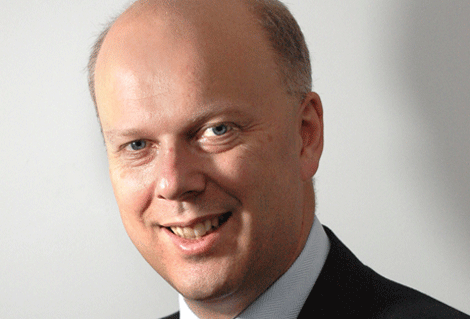
Interesting to hear the Work and Pensions minister, Chris Grayling, on Radio 5 Live this morning, sympathising with the unemployed.  He recognised things were tough out there and would be tougher, but he reckoned the private sector would, eventually, provide.

This is the absolute nub of the ConDem experiment, the sharp end of the debate about small versus big state.

The old Tory idea (which is what it is) that the state needs to be small in order for the private sector to thrive is based on two thoughts.

First, business doesn’t like bureaucracy.  Sausages have to be a certain shape!  Europe is bossing us about!  Get rid of this red tape!  Then business can thrive.  That’s a crowd-pleaser.   Not so much an economic argument, more a libertarian reflex.

The second thought is the posh one.  It’s the idea that when the state spends, it borrows money.  As it borrows “more and more” it needs to pay a better rate for its money, i.e. interest rates rise.  That affects mortgages and, crucially, the price of money for business.  Business cannot borrow, cannot invest, cannot hire.  This is known as the crowding out argument.

(Hard-line subscribers even call private sector jobs “real” to distinguish them from [presumably unreal] public sector jobs; I noticed Chris Grayling slipping in a “real”, psychologically to upgrade these new jobs he’s hoping will materialise.   Honestly!   Perhaps we should all go round town with a badge to show whether we’re doing a real job or a phoney, state-sponsored one.)

When asked where the vital new jobs would come from, Chris Grayling replied, “I’m not a crystal ball-gazer.”  He doesn’t know, and you can’t help feeling he’s happy with that; perhaps because the ‘real’ jobs are somehow only real when the minister for jobs has had nothing to do with creating them.  Not knowing becomes almost a badge of honour – yet another articulation of the government’s deft, cheerful retreat from responsibility for anything or anyone.

Chris Grayling may not know where the jobs are coming from, but he has listened to reliable institutions like our friend the OBR and they say it’ll be all right.  He went on to explain the crowding out argument.  And that, pretty much was that.  It’s hard for interviewers to argue against the crowding out argument.  It’s capital E economics and it shuts people up.

But you don’t have to know your monetarism from your Keynesianism to know that we’re running a massive deficit in this country.  And yet interest rates are virtually zero.  Whatever is holding business back, it can’t be the rate of interest.

What really motivates business to invest is the whiff of profit.  Sure, costs matter, and the cost of money matters.  But it couldn’t be lower.  What matters is sales.  Are punters going to buy our product?  Will they be spending?  Will they have pounds in their pockets?

If punters are unemployed, or fiscally squeezed, or saving for a rainy day in the light of dire government warnings about broken Britain, they aren’t going to buy your product.  No point investing, no matter how cheaply you can borrow money.  If government, at the same time, is slashing its spending like it has never slashed before, there’ll be no public sector demand either.  Time, you might decide, to pack up and go home.

That, in essence, is the debate.  Of course it is much more sophisticated than that, and I don’t profess to be an economist.  But I do know that the private sector is about people like you and me who spot the chance to make a buck  – who see a market they can sell into.  We are driven by opportunity.  We do not notice that the price of money is low and then ask ourselves what business we might want to set up in order to take advantage of those nice low interest rates.

Forget the intellectual argument and ask yourself if you would invest in a new business in the UK at the moment.  I know I would not.

I doubt Chris Grayling would either; when I listened to him trotting out the crowding out argument today, I didn’t think for a minute that he believed it.

The only crowding out that’s going on these days is the crowding out of reason and the shameless, cynical, oh-so-slick crowding out of responsibility.
 

The Naming Of Parts

13th July, 2010

One of my more infantile habits is to namecheck my friends in my scripts.   Almost every character has a name that means something to me, and mostly it’s my way of saying “hi” to someone important to me.  It’s something Anthony used to do, god bless his cotton, so it’s not even original; I am merely carrying on a sentimental family tradition.

Lovely, clever, adorable women are often called Sarah, for reasons you might be able to guess, or Louisa after my daughter (e.g. in Doc Martin), or Jane after our college friend who is one of the softest, kindest and best people I know.  I make that classic assumption that all Janes are like the Jane I know.  (Not that I know only one Jane, but this Jane is my main Jane, if you know what I mean.)

It’s very hard to break out of it.  And the flip-side is that a badly-named character can throw you off course when you’re writing.   Some characters can or can’t do things purely in virtue of the name they’ve been given.  For that reason I will sometimes stop and think for – well, too long – before I christen a character. 

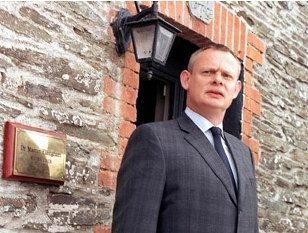
When I wanted Martin Clunes’ character in Doc Martin to be more real, more ‘mine’, more like me or my argumentative son, I gave him my surname in anagram form – Ellingham instead of Minghella.


Sometimes it backfires.  I have one friend who has noticed that his name is often given to unpleasant characters.  It’s true, but no reflection on him; it’s just that his name fits jerks better.  Try explaining that to a disgruntled old school chum.

I named the Sheriff of Nottingham “Vaizey,” and only after the deed was done did I remember that there had been a Vaizey at my college in Oxford.  We weren’t mates, so my subconscious had probably chosen the name judiciously; or rather, injudiciously: we’ve had some email exchanges lately, in which he revealed that he noticed, and that he drafted a (presumably stern) letter to me, but decided not to send it.  I don’t think any writer wants to receive a letter from a barrister about the use of his name.  Be especially careful if that barrister is going to go on to become the Culture Secretary.  For that reason alone, dear readers, do not try this at home.

Even if you don’t take someone’s name in vain, the fact that your stories are personalised in this way sets people looking.  I have a number of friends who think Doc Martin is based on them; one is a doctor called Martin, so you can understand that – except that the show was called Doc Martin before I was hired.  Others see a trait or a habit or a hobby in a character, or a turn of phrase, and assume I’m ribbing them.   I have found it useless to deny it, even when sometimes several people take the same evidence as proof that a character “really is” them. 

In the end of course, all writing is – and should be –  informed by experience, and so everybody and every thing springs from some sort of reality – which is why it’s important that us writer-types get out more often.

P.S. Some names are safe even from my childish pen.  Dante, my son, has a name it is hard to drop casually into a drama.  Gioia and Loretta, my sisters, are probably safe at least until I get somewhere with my film about Puccini.  But even in an Italian setting, Edana, my middle sister, is going to have little to worry about.  Edana is not an Italian name.  It is not really a name at all.  Our parents invented it.  They just liked the sound of it, so that’s why Edana is Edana.

But, dear Edana, like it or not, you shall go to the namecheck ball, and you can’t blame me for it.  You’re in The Archers!   You’re young, you’re fit, you’re a fine figure of a girl.  The mere sight of you was enough to make heartbroken Pip know she was home, where she belonged.  You are, my darling sister, a prize heifer.