Article: Light on Tufton Street

Is it the time of year? Or has the air changed in politics? In the mayhem of Truss’s economic catastrophe, are we witnessing the green shoots of Britain’s psychological recovery?
The way the air changes in September. Summer clings on, sometimes, but then there’s that familiar nip, and things suddenly feel different.

It’s not the first time the Tory governments of recent years have taken bizarre decisions against the interests of the British people, but it is the first time they have been so swiftly and so decisively called out.

A YouGov poll on Monday showed that, across all age groups, pretty much nobody had confidence in Truss’s government’s ability to tackle the rising cost of living.

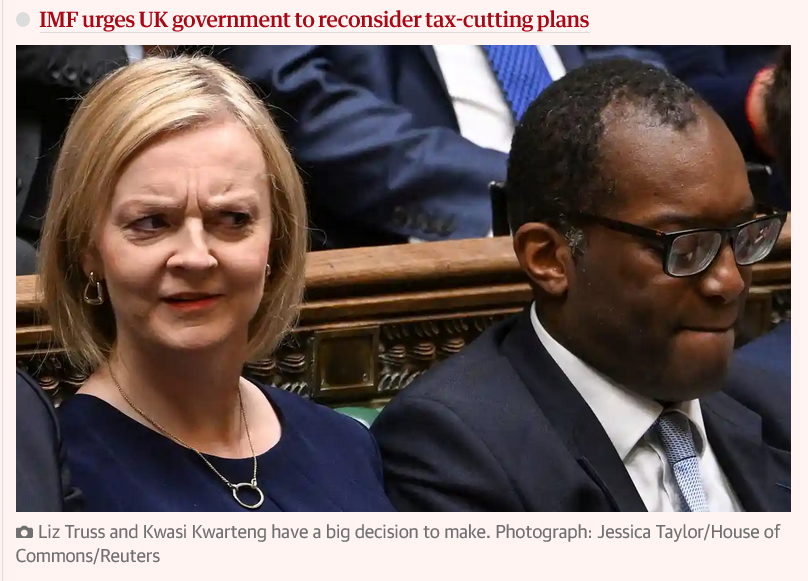
No doubt, the immediacy of the market response – the ‘flash crash’ of the pound – has helped the public to see the rashness of Kwarteng and Truss’s mini-budget for what it is.

Now even the IMF has issued its statement of dismay, summarised nicely here by the Have I Got News For You social media team:
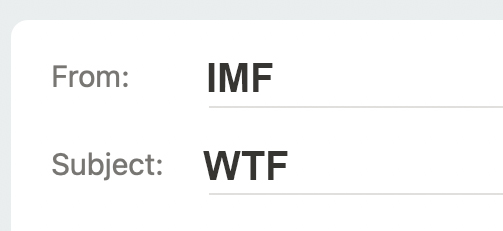
via HIGNFY

Perhaps the cabinet can be forgiven for thinking they would get away with it. After all, they got away with austerity, they got away with Brexit, and during peak Covid they got away with the siphoning off of public funds to friends, family and donors.

But the effects of Brexit were harder to see, masked by transition periods, covid, disinformation, and the blinding nature of faith. Brexit benefited also from a democratic mandate of sorts. Flawed, corrupt, and based on a mountain of shameless lies, but nevertheless there.

The present stance of Truss and Kwarteng, on the other hand, has precisely no mandate. Pouring scorn on redistribution, they have promised public money in unprecedented, economy-crashing sums to ‘big oil’ and gas, and tax cuts for the very rich – entirely disregarding their party’s repeated commitments to ‘level up’. It’s the opposite of a mandate.

No wonder the public is unimpressed. There’s no hiding this one behind ‘will of the people’. It is will of the hedge funders. It’s will of Tufton Street. It’s will of the arch libertarians and the disaster capitalists.

Speaking of Tufton Street, that’s something else that’s changed. The BBC has finally published an article, and radio programme, on ‘the other black door shaping British politics’.
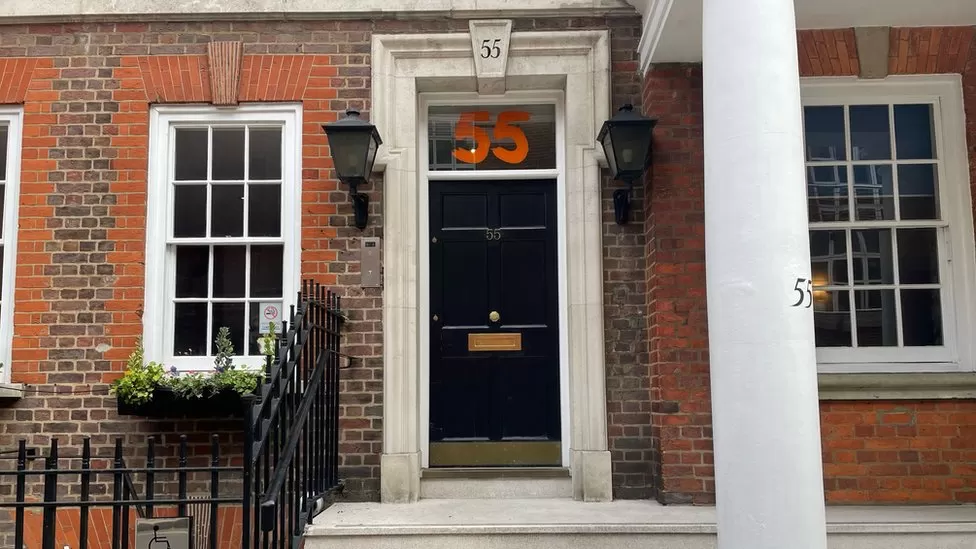
Tufton Street’s shady influence won’t be news to those familiar with the weeds of politics, but it might be news to the general public. Until now it seemed they didn’t want to know. But now, with such a bizarre departure from any semblance of fiscal caution, such a shameless favouring of the already wealthy, the public is inevitably going to ask what’s behind it. Where there is a bad smell, you look for the source.

Some of that bad smell emanates from the prodigious profits of hedgefunders who have bet against the pound and UK gilts, making big money out of our national misfortune.

(They did this before, of course, making substantial donations to the Brexit cause, only to reap gigantic rewards in the sterling slide which inevitably followed. But Brexit was different. That mandate again.)

The bad smell is particularly strong around the links between these hedge funders and our chief policymakers. They seem to have worked for each other, funded each others’ startups, and met up at what would appear to have been opportune moments.

Even if there has been (as is claimed) ‘no trading benefit from these relationships,’ the seemingly-close alignment of people, policy, prediction and profit is going to be hard to stomach for a public fretting about heating and eating, inflation and borrowing costs.

But locating the source of the smell is not just about who profits. It’s about why. What possible line of thought brings us here? Tufton Street provides much of the answer. We learn that its opaquely-funded outfits have been nurturing the likes of Truss since forever, inculcating in them their vision of the UK as a billionaire sociopath’s nirvana: small state, deregulated, safety-net free. We learn that now, with the successful installation of Truss in No 10, the UK has finally become their ‘laboratory’.
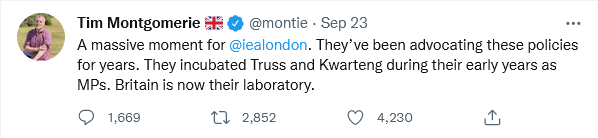
Yes, we are lab rats in a mad experiment. And they are saying it out loud.

Maybe that’s why the air seems to have changed at the BBC, too. Maybe that’s why it has chosen now to begin to shine a light on Tufton Street. It might not be the very first time it has done so, but it certainly feels like it. It feels like the BBC is daring to break free of its internally- and externally-imposed constraints.

BBC news’ reporting seems more direct in the last day or two, describing the economic fallout of Truss’s plans with cold, incisive clarity, for example, and reminding viewers, right up in the headlines, that a falling pound, by making imports more expensive, only worsens inflation, while requiring interest rate hikes – which further exacerbate the cost of living.

Watching and listening to their coverage, it really feels as if they’ve decided they’re not frightened any more. It really feels as if the BBC knows the Tories’ number is up, and there is no longer any benefit in kowtowing.

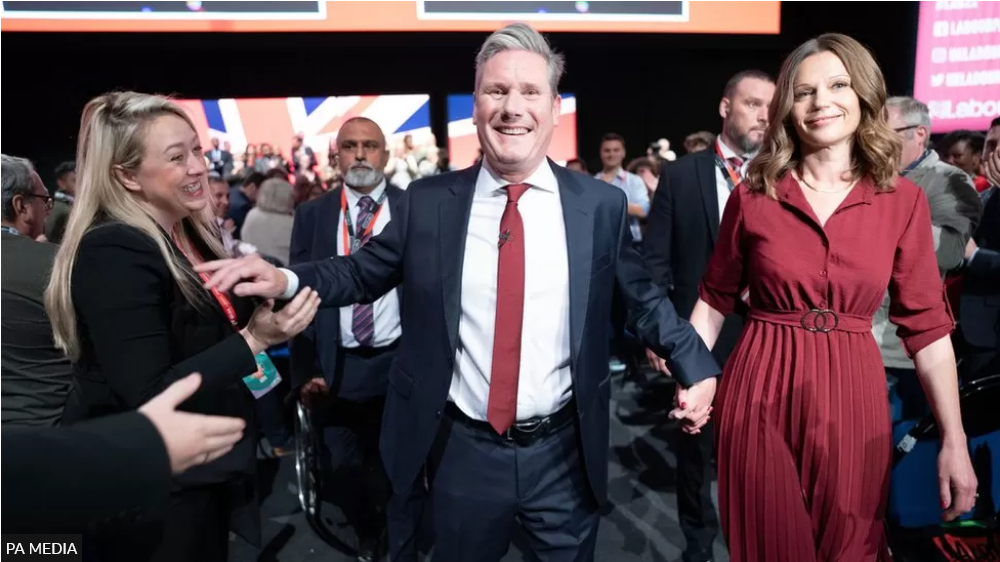
Meanwhile, in Liverpool, Labour seem to have had a remarkably upbeat conference. Delegates’ excitement was palpable. The intention to renationalise the railways, the bold green policy, the insistence on sound money. And above all, the confidence to paint a picture of a rosier future. I was struck by the lady who, interviewed after the leader’s speech, said that Starmer had restored her hope, after her husband died following a traumatic six-hour plus wait for an ambulance. She wanted someone to turn the NHS around, and Starmer convinced her that he would. Change was coming.
Perhaps most comforting of all are the little anecdotes you pick up here and there.  A couple of ladies in the hairdresser in affluent Esher, card-carrying Tories, overheard declaring that the tax cuts for the rich were ‘just not fair’. Or the die-hard Brexiteer in a family WhatsApp group finally saying he’s made up his mind to vote Labour – ‘Starmer’s got his act together, and the Tories have lost the bloody plot’. It might be September, but are these the green shoots of Britain’s psychological recovery?

None of this is to forget the power of the Tory campaigning machine. They won’t go down without a fight, and they fight below the belt. Anyone who is sure we’re on the brink of a ‘97 moment, and not a 1992 stumble, is naive.

But the British public, like its supine public broadcaster, seems to be waking up. For twelve years, the Tory emperors have worn no clothes. Suddenly, their dishonesty, their folly, their callous, naked greed, is there for all to see.

Updated 28 Sept 2022, 15:40 with minor tweaks and additional images.
Updated 29 Sept 2022, 14:47 to reflect Labour conference has finished.
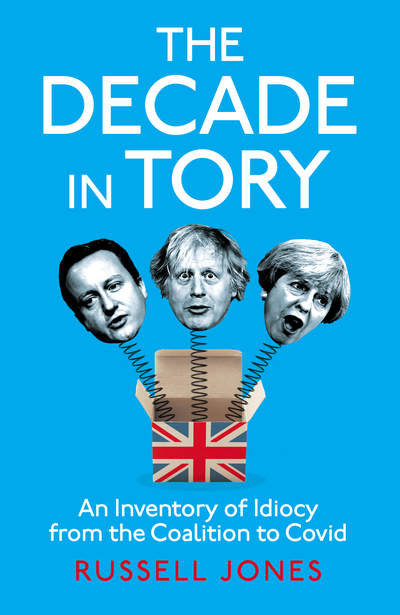
Review: The Decade In Tory, by Russell Jones

Do you have a politics junkie in your life? Then their next gift is in the bag. Russell Jones’ hugely impressive first book, The Decade In Tory is the politics junkie’s masochistic wet dream. Inspired inevitably by the mega-thread commentaries “The Week In Tory” which have shot him to deserved twitter fame, Jones brings his combination of forensic precision, clear-sighted overview, and cruel mockery to the dark decade of “Tory” beginning with the Cameron government of 2010.

Jones’ journey through the decade charts its twists and turns exactly as the reader remembers them. There is a sickening “oh my God, that’s right, they really did do that, and they really did say that” sensation of recollection, like flipping through a grotesque highlights album of the country’s downfall. Despite this familiarity, the startling claims and even more startling ‘solutions’ emanating from the dramatis personae of the decade in Tory sometimes seem so far-fetched that you want to pinch yourself, or at least check you’re not sharing in a hysterical dream. When that uncertain feeling comes over you, Jones provides ample footnotes in evidence. This stuff really is true.

But Jones doesn’t get lost in, or distracted by the detail. He moves with ease between macro lens and panorama, between the granular and the lofty, and sees the overall trends for what they are. His distaste for the Tories is writ large, but don’t be fooled; there is real political writing here too – thoughtful, informed assessment sits underneath the venom. That’s why his punches hit home, both in his online commentaries and in this substantial book. Jones knows his oats.

For all his smarts, Jones is also rude. “You may have never kissed a Tory, but you’ve still probably spent most of your life being fucked by them.” Of Grant Shapps, he writes, “he had more identities than Jason Bourne, somebody else who people would travel half way around the world to punch.” Jacob Rees-Mogg is described as the result of a Dalek having hate-sex with a pendulum. You get the gist. Some may see this as puerile, but the utter contempt in which he holds the protagonists – or is that antagonists? – in his story entirely justifies, and even demands this level of vituperation. There is plenty of dispassionate political commentary out there, which too often describes hateful political ideas and deeds without taking the logical next step of attributing hatefulness to the characters involved. No such pussy-footing around here. Jones is merciless. Progressives tend to pull punches with the occasional damning quip, while the hard boys of Brexit and beyond use language with blunt effectiveness. For those of us who see the world as Jones sees it, a new critical vocabulary is needed, and if the character assassinations here feel a little uncomfortable, that only serves to underline the point. A new school of informed, forthright opprobrium is growing among the stars of progressive twitter, and Jones’ voice shines among the very brightest.

This book will comfort you. It will confirm for you that the grim decade in Tory was as you remember it; you haven’t gone mad, even if the Tories have. It will sadden you, too, for exactly the same reason. The UK really has plummeted from premier league to non-league in just a few seasons, and at great human cost. (As a barometer of this decline, Jones repeatedly cites the year-on-year increase in the number of Britons reliant upon foodbanks. Each citation is more sickening to read than the last, and the cumulative effect is nothing short of enraging.) And this book will entertain you. There is a bleak comedy to this ‘inventory of idiocy’ as Jones calls it, and you can’t help but laugh as he celebrates it.

The Decade In Tory is a bravura performance. Substantial, meticulous, incredible, depressing, hilarious, rude – and essential reading.


The Decade In Tory by Russell Jones is published by Unbound on 27 October, 2022.
Russell Jones on Twitter: @RussInCheshire

Article: I Was At School With Steve Bray

I was at junior school with Steve Bray. Steve was smart but rebellious. He looked at the rest of us like we were dunces when our teacher asked if anyone knew what the ‘DC’ in Washington, DC stood for. Someone said ‘Democratic County’ and Steve shook his head in despair. Steve’s brother was a certified genius and had been helicoptered off the Isle of Wight to a scholarship at some glamorous school for geniuses on the mainland. Steve probably had identical smarts, but less good fortune.

Steve was the bane of our authoritarian teachers’ lives. When we were very little, they taught us how the Romans brought civilisation to Britain. Steve threw up his hand and said, ‘Do you call strapping a man to a boulder and then rolling that boulder down a hill civilised? Because I don’t.’ This didn’t go down well.

Aged about nine, Steve’s IQ was assessed at over 156 on the Wechsler scale. He was extremely widely read, and knew more about most things than most teachers. When he challenged them, it was hard for them to admit error, and they needed to ‘win’, to save face and keep order. Their arguments boiled down to ‘because I’m the adult here’. He would counter with the question, ‘How does being born at an earlier date than me make you right?’

Steve was an atheist and didn’t want to attend school ceremonies at the nearby church. The school insisted it was an integral part of our community life. At Harvest Festival, with donated food bedecking the long tables, and parents in best bib, the chaplain talked about sacrifice being at the heart of Christianity, with the symbol representing Christ’s sacrifice at the centre of it. Steve put up his hand: ‘I think you’ll find the cross predated Christianity, and was in fact a pagan symbol adopted by the Church.’ Steve was barred from attending school church services after that.

For all his brashness, Steve was an astute reader of people. One of our teachers used to devise spelling tests notionally for the whole class, but which in fact were targetted at me. I was a good speller, and he wanted to catch me out. I expect I enjoyed this attention, but Steve suggested that the guy had a prurient interest in me. (His words were blunter than that, but I’ll spare you.) I think I knew deep down he was right, and possibly Steve alerted me to, and saved me from, potential trouble there.

Steve refused to follow the rules and wear his cap en route to school, and the sadist in charge of discipline made it his business to call Steve into the tuck shop, where he kept his bittersweet lair, and beat Steve hard with a shoe. Steve was tough, but the beatings were tougher. I’ll never forget his broken face, thick with tears as he left the tuck shop after a particularly severe thrashing, clutching his rear. His bravado was gone, replaced by the shock of pain, shame and raw fear.

But bravado was Steve’s fallback. He used to encourage me to play truant, and once the sadist came by in his car – surely not by chance – and wound down his window to ask if we were, as we had informed the school, unwell. I hung back, frozen in fear. But Steve took a drag on a cigarette and leaned into the sadist’s window, and blew the smoke into his face. ‘Very,’ he said. I couldn’t believe the daring.

We lost touch when I left that horrible school, but I gather Steve was expelled soon after.

I met him again at college, where he had morphed into a mouthy socialist worker. He riled our teachers with brilliance of mind, rigidity of argument and incapacity to conform. He talked openly in class about his reliance on cannabis, and did precisely no work. He was cleverer by miles than me, and knew more about politics and philosophy than I will ever know, so, arguably, precisely no work was the amount he needed to do. He was perhaps not the greatest of abluters, and his sweet, defiant, gifted maladorousness went with him when he was ‘sent down’ after a couple or three terms.

Another Steve Bray – and by now you may be suspecting, correctly, that these Steve Brays are not the one who was arrested yesterday in Westminster under the new ‘noisy protest’ law, and are creative amalgams of individuals I have known – was a gifted university philosopher. A maths prodigy plucked from poverty and sent to Oxford at 16, he was the sharpest mind I’ve known to date, and a brilliant, empowering and illuminating teacher. His colleagues more or less hated his guts. His unwashed and unkempt presentation, his verboten cigarettes in the hallowed halls, his popularity with enthralled students. And above all, his incessant challenge. Like new-Bray-on-the-block, Mick Lynch, he would gladly, and firmly, fix a fellow don with a hard stare and state, ‘You Are Wrong. That Is A Lie.’ He demolished arguments with a devastating flick of the intellectual wrist, and left distraught scholars lost in the ruins of their painstakingly-built theses. He was never given tenure.

I’m guessing at your school, or your college, or your place of work, or in your family – somewhere in your story, there is a Steve Bray. Someone who tells it how it is. Someone with a good brain who can’t be quiet, can’t be polite, can’t help standing up to authority.

In my experience, the Steve Brays of this world speak for those of us who are too shy, too conformist, too cautious, too careful to pipe up. In doing so, they put their heads above a dangerous parapet. We all know – and even THEY know – that it is only a matter of time before the powerful take them down. Even when they are right – especially when they are right – they threaten order. They cannot be tolerated. If existing rules cannot be brought to bear against them, new ones will be cooked up to do the job.

The rest of us hang back, keeping our distance, not wanting to go down with them. We tell ourselves there are better ways to make the points they are making. More nuanced ways. More polite ways. More constructive ways. We tell ourselves, perhaps, that some systems are better reformed from the inside, justifying our conformity. We tell ourselves that, in the end, these guys are society’s losers, and it’s a shame, but their way is not the right way.

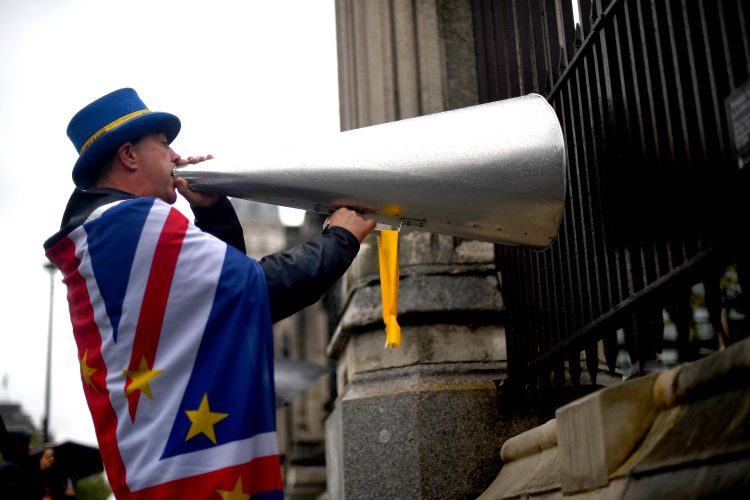
I have also met the real Steve Bray. The “Stop Brexit” Steve Bray. But I can’t say I know much about his story. I don’t know if he’s unusually clever, like the others I’ve known, or was beaten at home, like one I’ve known, or a little bit ‘on the spectrum’, like the ones I’ve known. I don’t even know if he’s a good bloke, decent though he seemed when we chatted. Like all the Brays I’ve met and you’ve met, I highly doubt he is a messiah, and I’d be surprised if he wasn’t a very naughty boy.

But I do know this. He speaks the truth. If “Stop Brexit” Steve had been wrong, and Brexit had turned out to be all sunlit uplands and Britannia ruling the waves, he’d be a forgotten irrelevance by now. ‘That bloke with the hat,’ we’d say. ‘The one with the megaphone. What was his name?’

But he wasn’t wrong. Brexit has demonstrably torpedoed our economy, our unity and our international standing. It has damaged us below the waterline, and he was right to warn us. Ain’t no megaphone loud enough to get that existential message across.

Is he wrong now on corruption inside government? Hardly. From a ‘system’ in which the Prime Minister polices himself, to the wholesale dispensing of public funds to friends, family, donors and client media, the corruption charge appears all too real.

To this corrupt regime – to this Vote Leave regime – Bray isn’t just a pain in the arse armed with a megaphone; he’s a pain in the arse armed with the truth.

So, like all the Brays I’ve met and you’ve met, they will stop him. Make no mistake, he will lose. They will take him into their tuck shop and whoop his ass. The question for the rest of us is are there really politer, more constructive, more effective ways to speak truth to this particular brand of corrupt, dishonest and self-policing power? Or to put it another way, when he eventually exits the tuck shop a broken man, will we, who did not stand with him, be able to meet his gaze?

I’m Not Listening To The Spring Statement. Here’s Why

I’m not listening to Chancellor Sunak’s Spring Statement.

Here’s why.

He’s already told us what we need to know: ‘The government cannot be expected to solve every problem.’

He’s not kidding.

He and his government have certainly created enough problems.

They’ve cocked up our supply chains with the sclerosis and bureaucracy of their botched Brexit. They’ve pushed workers away so that we can’t pick our fruit, we can’t pick our vegetables, and our farmers can’t bring their meat to market because they don’t have the staff to do the job.

Road hauliers, pushed away by Brexit, aren’t here in sufficient numbers, so that what we do have, we can’t distribute.

All of these contribute to inflationary pressure.

We can see it in the prices at the shops, rising each and every week.

Inflation is running wild, and wages and benefits aren’t keeping up. Everyone is poorer.

Adding to this problem – not solving it – will be Sunak’s National Insurance rise. This is a tax – on workers and employers – at exactly the wrong time.

He has let it be known that he might tweak the thresholds at which this additional tax bites, but really? Big f*cking deal. There should be no NI hike at all. There should be a reduction.

And don’t forget, these guys are masters, absolute masters – with weasel words and diverting headlines to distract the media – at making it look like they are giving, when in actual fact they are taking away. They’re brilliant at it. For a day or two, in all the hullabaloo and earnest analysis, we can’t see what they’ve done. Only when the smoke clears, a week or three later, does it become clear. And by then it is too late.

This time, let’s not be fooled.

Because for a dozen years, that is precisely what they have done. Under the guise of prudent economics and a ‘balanced approach’, they’ve chipped away and chipped away at our infrastructure, our health service, our local services and our benefits, and now, when the British people face a historic cost of living crisis, what have they got for us? Nothing. They ‘can’t be expected to solve every problem’.

On energy prices, they’ve promised a loan to offset soaring price hikes. A loan! This is your government, in your hour of need. Men and women paid by you to really grip problems. But they say they ‘can’t be expected’ to help you, and instead they’re behaving more like payday loan sharks, bunging you a few quid now, only to come back later to claw it back, when you’ll probably be in an even worse position.

On fuel, they’ve said they might take 5p off a litre of fuel. 5p! 5p is what Tesco might offer you as a reward for doing your shopping there. It is not what a government does to remedy a dramatic crisis. And remember, half the pump price is fuel duty and VAT. Sunak will still be taking about 80p from you in tax for every litre you buy.

VAT remains on energy too. As the prices rocket, so does Rishi’s revenue.

He can afford to do more.

We cannot afford for him to do so little.

Rishi Sunak and his family are richer than Queen. He is a man who will never, ever have to worry about the price of a meal, the price of fuel, or the cost of a warm home. Never. Rich people can make fair choices for all, but they cannot know the fear and the disabling horror of lying awake over how to pay for the basics. If they did, they could never say, in the face of a historic crisis, that they ‘can’t be expected to solve every problem’. Such a sentence wouldn’t even flash across their minds.

When he says he can’t be expected to solve every problem, he really means he’s not going to solve any problem. He really means ‘suck it up’. The ‘whatever it takes’ Chancellor has, in short order, become the high tax, no heart Chancellor. The ‘whatever it takes for me to build a war-chest for the next election (when I might be leader)’ Chancellor.

On their own admission, the Tories ‘can’t be expected’ to solve our problems. Their record, from austerity to Brexit, proves the contrary: they’ve created and contributed to our problems. They’ve ground Britain and its people down for a dozen years. It’s time for change. It’s time to take the country back from people who just don’t get it. It’s time to #takebackBritain.

You can join #takebackBritain at www.reimagine.uk.com