What Have I Done To David?

29th September, 2010
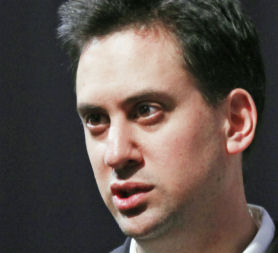


Is it just me, or did the cutaways during Ed Miliband’s first speech as Labour leader reveal a squirming, rueful conference audience?  Is it just me, or did those expressions read: Dear God, what have we done?


Clearly a lot of those present had supported Ed’s leadership campaign.  And those who hadn’t will now get in behind him for the good of the party.  But whichever camp they had been in, it looked as if it was suddenly dawning on all of them: David would have to go, and the Labour front-bench would lose its most charismatic player.


Some of them will have been thinking: we need the break from the past that Ed offers us.  Others will have thought we may not have needed it, but let’s take it anyway and draw some lines under Blairism, Brownism, Iraq.  But mostly I reckon they were thinking: what have we done?


It’s as if Labour had always assumed it would be able to have both Milibands on the team.  It could have had Ed under David.  But it could never have had David under Ed.  Did nobody think that through?  I know I didn’t, but that’s because I thought David would walk it.


Ed won it on the 5th round, and on the union votes, not those of the PLP or ordinary members.  When we see Ed speaking for Labour, we’re going to see a man who is there because of the unions.  That is not undoable, and it is an electoral handicap.  It will identify Ed with the forthcoming union resistance to the Coalition’s cuts, which in turn will make a nuanced Labour position on the deficit impossible.  The Conservatives, who have succeeded in keeping the argument binary – you either cut or you spend – could not have scripted a better outcome.


When we see Ed speaking for Labour, we’re going to see the man who denied us David; the man who got where he got by stabbing his own brother in the back.  Ed’s supporters can argue all they like that he had the right to stand, even the duty to stand.  Of course.  But the reality is that Ed’s success required the political assassination of his brother, while David’s did not. 


Ed seized his chance.  He had seen his own brother dither, and he wasn’t going to do the same thing.  (Although it’s said that Ed helped persuade David not to stand against Brown, ironically.)  In the end Ed’s was a winning decision, and you can’t take that away from him.  But was it thought-through?   Rumour has it that, when he learned of his victory, Ed turned to Sadiq Khan and asked, “What have I done to David?”  Whether that rumour is true or not, the victory already seems Pyrrhic, the stage already lacklustre without David’s presence.


The ‘Harman moment’  (in which David rebuked her for applauding Ed’s anti-Iraq stance) proved that David had no choice but to retreat to the back benches.  Labour’s only hope is that this retreat will work, that the man whom a thrilled Hillary Clinton described as “vibrant, attractive, vital” can melt into the political background.  That is Ed’s only chance of a ‘clear field’ in which to define himself and ‘NextGen’ Labour. 


I’ll believe it when I see it.

The Urgent Truth

5th August, 2010


On Monday 7th June (see here) Prime Minister Cameron argued that his actions were necessary and unavoidable.  We don’t like what we’re doing, but someone’s gotta clear up the mess. He said:


“We are not doing this because we want to. We are not driven by some theory or some ideology. We are doing this as a government because we have to, driven by the urgent truth…”


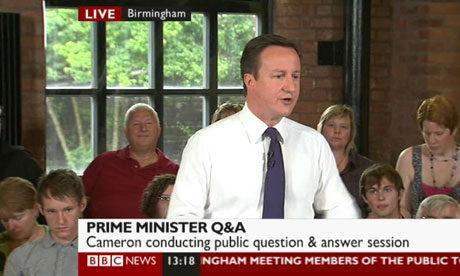
David Cameron answering questions from the public in Birmingham on 3 August 2010.


Yesterday, 4th August, the Prime Minister addressed a “PM Direct” event in Birmingham.  He was asked by a local fire brigade worker:


“Will you give me a pledge today that when these austere times are over, and you have the money back in the bank or you’re balancing your books, that you will look at anything that is cut during this period and go back and get those fire engines back in the places they are needed to support the public?”


Mr Cameron did not give the pledge.


“The direct answer to your question – should we cut things now and go back later and try and restore them later?  – I think we should be trying to avoid that approach.”


Surprise, surprise, Cameron doesn’t intend to restore public services when the deficit has been repaid.


He is not cutting public services because the money isn’t currently in the bank.  He’s not clearing up a mess.  He is not, as he claimed on 7th June, driven by an “urgent truth”.  He is not doing it “because he has to”.


He is doing it because he wants to.


Crowding Out: The nub of the NotMeGov credo

14th July, 2010

Interesting to hear the Work and Pensions minister, Chris Grayling, on Radio 5 Live this morning, sympathising with the unemployed.  He recognised things were tough out there and would be tougher, but he reckoned the private sector would, eventually, provide.

This is the absolute nub of the ConDem experiment, the sharp end of the debate about small versus big state.

The old Tory idea (which is what it is) that the state needs to be small in order for the private sector to thrive is based on two thoughts.

First, business doesn’t like bureaucracy.  Sausages have to be a certain shape!  Europe is bossing us about!  Get rid of this red tape!  Then business can thrive.  That’s a crowd-pleaser.   Not so much an economic argument, more a libertarian reflex.

The second thought is the posh one.  It’s the idea that when the state spends, it borrows money.  As it borrows “more and more” it needs to pay a better rate for its money, i.e. interest rates rise.  That affects mortgages and, crucially, the price of money for business.  Business cannot borrow, cannot invest, cannot hire.  This is known as the crowding out argument.

(Hard-line subscribers even call private sector jobs “real” to distinguish them from [presumably unreal] public sector jobs; I noticed Chris Grayling slipping in a “real”, psychologically to upgrade these new jobs he’s hoping will materialise.   Honestly!   Perhaps we should all go round town with a badge to show whether we’re doing a real job or a phoney, state-sponsored one.)

When asked where the vital new jobs would come from, Chris Grayling replied, “I’m not a crystal ball-gazer.”  He doesn’t know, and you can’t help feeling he’s happy with that; perhaps because the ‘real’ jobs are somehow only real when the minister for jobs has had nothing to do with creating them.  Not knowing becomes almost a badge of honour – yet another articulation of the government’s deft, cheerful retreat from responsibility for anything or anyone.

Chris Grayling may not know where the jobs are coming from, but he has listened to reliable institutions like our friend the OBR and they say it’ll be all right.  He went on to explain the crowding out argument.  And that, pretty much was that.  It’s hard for interviewers to argue against the crowding out argument.  It’s capital E economics and it shuts people up.

But you don’t have to know your monetarism from your Keynesianism to know that we’re running a massive deficit in this country.  And yet interest rates are virtually zero.  Whatever is holding business back, it can’t be the rate of interest.

What really motivates business to invest is the whiff of profit.  Sure, costs matter, and the cost of money matters.  But it couldn’t be lower.  What matters is sales.  Are punters going to buy our product?  Will they be spending?  Will they have pounds in their pockets?

If punters are unemployed, or fiscally squeezed, or saving for a rainy day in the light of dire government warnings about broken Britain, they aren’t going to buy your product.  No point investing, no matter how cheaply you can borrow money.  If government, at the same time, is slashing its spending like it has never slashed before, there’ll be no public sector demand either.  Time, you might decide, to pack up and go home.

That, in essence, is the debate.  Of course it is much more sophisticated than that, and I don’t profess to be an economist.  But I do know that the private sector is about people like you and me who spot the chance to make a buck  – who see a market they can sell into.  We are driven by opportunity.  We do not notice that the price of money is low and then ask ourselves what business we might want to set up in order to take advantage of those nice low interest rates.

Forget the intellectual argument and ask yourself if you would invest in a new business in the UK at the moment.  I know I would not.

I doubt Chris Grayling would either; when I listened to him trotting out the crowding out argument today, I didn’t think for a minute that he believed it.

The only crowding out that’s going on these days is the crowding out of reason and the shameless, cynical, oh-so-slick crowding out of responsibility.