Now Is Not The Time

Why aren’t the British people furious? As we sit sheepishly indoors, in fear, for ourselves and our loved ones – and, increasingly, in mourning – with no realistic prospect of an end to lockdown, wondering just how sky-high these appalling death tolls will go, wondering how our economy will look if and when the new dawn comes, wondering how to earn money in the meantime, wondering how, safely, even to buy food, why aren’t we screaming blue murder at our embarrassing, disgraceful, criminally-negligent excuse for a government?

It’s not, I think, that the PM wound up in hospital and by some accounts nearly died – though that did give us pause. Even his detractors were shaky when he went into hospital, including, I’ll admit, me. But, human-story distraction though that was, it’s not the underlying story.

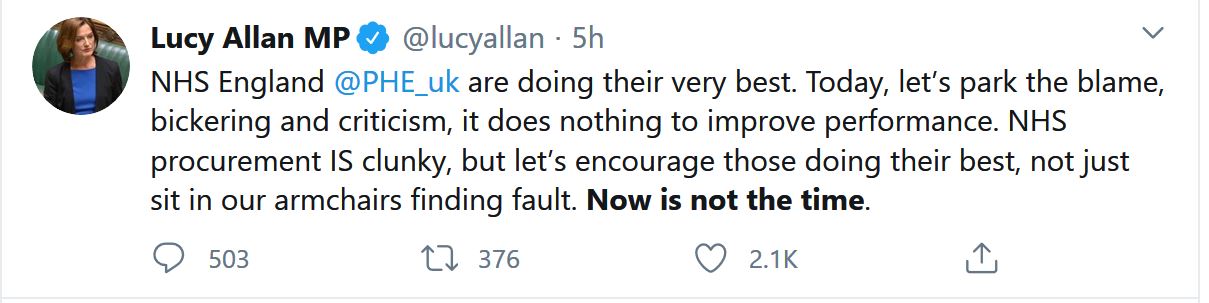
I suggest the real reason we are not, yet, furious is that we are being successfully played on two, related fronts. First, we’re being told ā€œnow is not the timeā€ to challenge leaders and scrutinise their choices. [E.g. Lucy Allan MP’s tweet, pictured. And a number of other MPs tweeted along similar lines, in what was clearly an instruction from Conservative HQ.]  We are not, for instance, to question their reliance on ā€œtheā€ science, even if that science might appear to be entirely at odds with the science of the World Health Organisation, other countries, and common sense. To express concern is to be unpatriotic, is to undermine the ā€œHerculeanā€ collective effort, even to undermine the NHS and our heroes on the front line, just when they need our support most.

Clever.
Scrutiny, then, is not for now, while we’re in the thick of crisis. The unspoken implication is that there’ll be a time for questions later, when the hurly-burly’s done; then (but only then) there can be investigations and inquiries. As if inquiries ever proved to be anything other than lost balls and long grass.

Second, we’re being invited to think of our country as being ā€œat warā€ with the virus. [E.g. “We must act like any wartime government.” – Johnson, 17 Mar 20.  “This national battle” – Johnson, Easter Sunday.] This language also inspires – and demands – unity, stifling healthy criticism and debate. After all, we are, surely, together in this. We must all play our part. Undermining leadership at a time of war is tantamount to treason. It takes a brave soul to speak up, to put his or her head above the parapet in such circumstances. But it’s a false notion of course. The virus doesn’t know who we are. It does not think it has ā€œthe UKā€ in its sights. There is no war. The language and metaphor of war is being deployed, not to make our situation clearer or easier to understand, but to insulate those responsible for serial failures from scrutiny and blame.

Clearly these are related tactics, deliberately designed simultaneously to deflect blame and silence the masses. And, so far, they are working.  If surveys [e.g. by YouGov] are to be believed, a startling number of us feel the Government is doing a good job. Friends, let’s see this for what it is, expose it, and fight back. Thousands of us are dying every day. How many of those deaths are down to incredible paucity of leadership? If we are not to be angry now, then when?

This post brings together two twitter threads I wrote today:

1. Now is not the time.

Now is not the time to ask Where are the masks and the gowns?

Now is not the time to ask Where are the tests?

Now is not the time to ask Why don’t the tests work?

Now is not the time to ask why we’ve bought millions more tests – and they don’t work, either.

Now is not the time to ask Where are the Rolls Royce ventilators?

Now is not the time to ask Where are the Dysons?

Now is not the time to discuss pay rises for nurses.

Now is not the time to ask when the financial support – if it is real – will actually arrive?

Now is not the time to ask Why didn’t we act earlier, when we knew this was coming?

Now is not the time to challenge the government.

Now is not the time for Parliament to be recalled.

Now is not the time for journalists to challenge Ministers.

Now is not the time to ask why ‘herd immunity’ was a serious strategy.

Now is not the time to ask, lockdowns aside, whether ‘herd immunity’ is not still the strategy.

Now is not the time to ask How do we actually get out of this?

Now is not the time to ask Who’s actually in charge?

Now is not the time to depress people.

Now is not the time to frighten people.

Now is not the time.

Now is not the time to ask whether our loved ones, in their thousands, needed to die.

Now is not the time to ask How many more of our loved ones need to die?

Now is not the time.

2. I’d call it a war, too

I’d call it a war, too, if I wanted to characterise myself as Churchill. If I wanted people to look outwards, somewhere else, over there, to a conveniently invisible enemy, and rally blindly behind me.

If I wanted to deflect responsibility for my hollow words, my failure to deliver even basic testing, masks and gloves. If I wanted to divert attention away from my arrogant denial of the threat, even though it was clearly coming.

I’d call it a war, too, if I wanted to divert attention away from my murderous, eugenicist, early policy of “herd immunity”. From my lies about being “guided by the science” while ignoring the advice of the WHO and countries already in crisis.

I’d call it a war, too, if I wanted to divert attention away from the complete absence of an exit plan, from my failure to put in place the infrastructure of tracing, home testing and domestic monitoring so that lockdown could actually one day end.

From my ideological refusal to accept help from, or co-operate with, the EU, even if it costs British lives. From my party’s failure to back the NHS for a full decade, its decimation of the police, social care and so many front-line services we now know are literally vital.

I’d call it a war too, if I thought I might get (and deserve) the blame for leading a country towards the highest death rate in Europe. I’d call it a war, too, if I were playing any part in this murderous, inhuman government of spin, lies and criminal negligence.

I’d call it a war, too, if the language of a common, external, military enemy were my last shield, my only hope, the only remaining explanation for the blood of thousands of fellow citizens on my hands.


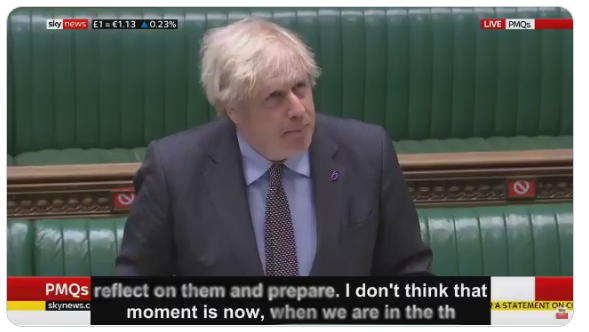
Top image added 27/1/21 – sadly now is still not the time.

My experience of hospitalisation with Covid-19 here.
What Would A Second Referendum Prove Anyway?

On a momentous day in which hundreds of thousands marched (again) for a People’s Vote, and Boris Johnson tried and failed to railroad Parliament into accepting a deal he’d only shown them two days previously, the possibility of a People’s Vote is once again being discussed.
Ā 
Soon after the chaos in Parliament, Tobias Ellwood went on the BBC to decry the value of a 2nd Referendum.
Ā 
He used a well-worn argument, which went unchallenged.
Ā 
You’ll have heard it many times, and not just on the telly, but probably also down the pub.
Ā 
It comes in several variants, which all boil down to the “What Would It Prove Anyway?” argument.
Ā 
Typically it goes like this:
Ā 
“Say there was a 2nd vote, and it went marginally for Remain – what would that prove? It wouldn’t settle anything. Imagine it’s 52/48 for Remain. That’s the same as Leave got first time round. What would you do then? Have another vote? Best of three? Four? Five? It would be ridiculous. We’ve had a vote, the people have spoken, let’s get on with it.”
Ā 
As a pub-style argument, it works pretty well, doesn’t it?
Ā 
Except there’s a technical term for it: it’s bollocks.
Ā 
It’s bollocks because a 2nd Referendum which went 52/48 to Remain would either be significant, or it would not.
Ā 
If somebody argues that it 52/48 is not significant, then they must admit that the first referendum was similarly insignificant, and therefore is not the basis for major constitutional change. (Correct, of course.)
Ā 
If, on the other hand, 52/48 IS deemed significant, then the fact of a vote now going that way for Remain would be evidence that there is no longer any basis for major constitutional change.
Ā 
Either way, such a vote would spell the end of Brexit.
Ā 
Whichever way you cut it, a 52/48 split is no basis for major constitutional change.
Mocking the notion of a wafer thin majority for Remain in a 2nd Referendum only underlines that point.
Ā 
Clever though it at first seems, Tobias Ellwood’s argument – and the argument of your mate down the pub – in fact is self-defeating. Because if a close-run second referendum can’t settle Brexit, then a close-run first referendum can’t either.
Ā 
In mocking close referendum results, all they prove is that we should never have gone down this deeply unpleasant rabbit hole in the first place.
Ā 
[The video here is Ellwood making the same argument earlier in the year.]
Ā 
Ā 

We Voted Three Times To Leave!

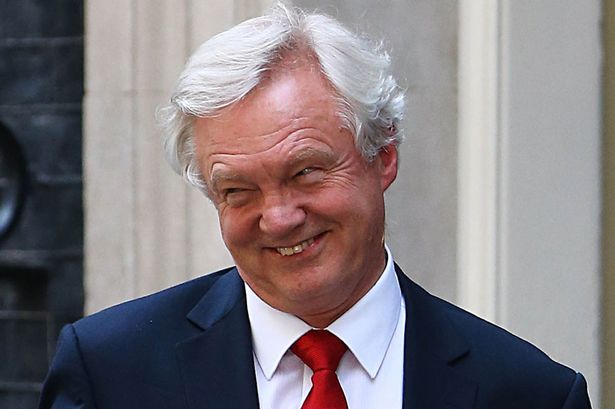
David Davis MP, former Brexit Secretary.

It’s an argument that Leavers keep trotting out.Ā  I heard David Davis on BBC Any Questions repeat it only yesterday, 20th September 2019.

It goes like this: the public voted overwhelmingly for Brexit.Ā  First, in the 2016 Referendum.Ā  Second, in the 2017 General Election, in which over 80% of votes were for parties “respecting the referendum”.Ā  And thirdly, in the 2019 EU elections, in which the Brexit Party won most seats.

There’s a technical term for this argument: it’s bullshit.

THE 2016 REFERENDUM

First, the 2016 Referendum was won on a wafer-thin majority, of 51.89% to 48.11%.Ā  That is not “overwhelming”.Ā  In a town hall meeting of 101 people, 49 of them would have been Remain.Ā  In such a show of hands, you’d be hard pressed to conclude anything but division, right down the middle.Ā  No conclusion; no decision to be inferred; no action to be taken.

Of course the referendum wasn’t just close, it was bent. Many were excluded from the franchise (including many UK citizens living abroad, and EU citizens living in the UK – all of whom are in the direct firing line of any Brexit policy). The Leave campaigns broke the law, harvested our data with the help of Cambridge Analytica, and funded their dark ops with money sourced from god knows where.Ā  Over a billion Facebook ads were “dropped” in the days before the vote, and we don’t know much about them because they were tailored, but it’s safe to guess that they were as honest as the lie on the side of the Leave campaign’s bus. Investigations are ongoing.

THE 2017 GENERAL ELECTION

What about the General Election of 2017?Ā  Over 80% of us voted for parties supporting Brexit.Ā  Isn’t that the mandate to trump all mandates?Ā  It’s true that Labour talked a positive talk on Brexit.Ā  But they have famously equivocated, trying to hold their Remain supporters on-side.Ā  Many, or probably most, Labour voters did so while holding their noses on the party’s Brexit stance.Ā  They voted Labour for many reasons, but not for Labour’s Brexit position.Ā  They voted Labour because they hoped the Brexit stance would change, or because their local MP assured them that it would, or because they had no decent local alternative, or because they were tribally Labour, or because they valued Labour’s policies on matters not related to Brexit, or because they were loyal to a hard-working incumbent MP.Ā  I was one such voter.Ā  You may NOT count my vote as a pro-Brexit vote.

If you want further evidence of support for or against Brexit, hold a Brexit referendum, not a General Election.Ā  (A fair, inclusive, legal and honest one this time, please.)Ā  The General Election results of 2017 tell us next to nothing about popular support for Brexit.

THE 2019 EU ELECTIONS

What about the big win for the Brexit Party in the 2019 EU elections?

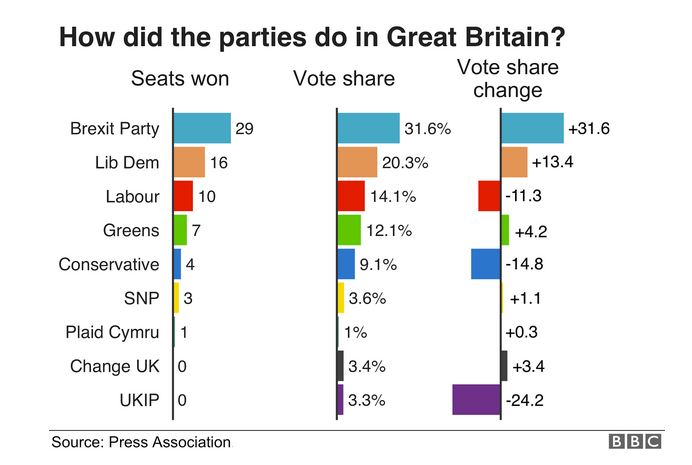
EU Elections 2019 PA/BBC

The Brexit Party won a whopping 29 seats and 31.6% of the vote.  Impressive.

But was that an overwhelming vote for Brexit? Combined with the Tories’ 9.1%, the pro-Brexit vote was 40.7%. 

Voters’ support for Labour MEP candidates like Seb Dance, who had demonstrated great commitment to our membership of the EU, cannot be added to that 40.7%.  40.7% does not constitute a majority.

The 2019 EU Elections did not show a majority for Brexit.

The 2017 General Election doesn’t tell us anything about popular Brexit support.

The 2016 Referendum – bent, bought and restricted – delivered an inconclusive verdict.

When you hear the likes of David Davis peddling the lie that the people voted “not once, not twice, but three times” for Brexit, you could be forgiven for asking yourself why, three years on, the lie is even necessary.  Shouldn’t the supposed mandate be irrelevant by now, as we contemplate the coming-to-bloom of those much-vaunted Brexit opportunities? Shouldn’t we be readying ourselves for our moment in the sun, our arrival on the global political stage, our imminent economic dominance, our glorious freedom?  The question of why we’re doing this, and on what basis, should long ago have been forgotten and displaced by the heady scent of obvious benefits, just around the corner.

Or is this “once, twice, three times a lady” argument the only song the David Davises of this world have left to sing?