The New Normal 4

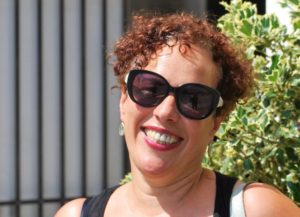
by Edana Minghella in Liguria, Italy.

Sunlight through a few clouds, a hint of a breeze, warm enough to be out with just a thin jumper over a vest. I skipped downhill towards the town and the seafront, marvelling at the vibrant orangey-pink of a neighbour’s climbing dog rose and the deep purple of a mass of wisteria, pausing to peep through the gate of another’s tiny, perfect garden overlooking the sea, jaunting through the olive grove to the cackle of a pair of jays, and finally stopping to take a photo at the “sweet spot”: the point where the terracotta path curves, revealing the deep blue of the sea ahead, the promontory of Porto Venere and the islands of Palmaria and Tino, all framed by the fronds of the tall palm tree in the garden of the grand villa on the corner. I’m out. I’m out for a walk for the first time in almost 7 weeks.

Italy’s lockdown has been harsh. “Brutto”, as they say here, with a shake of the head and a hunch of the shoulders and a lift of the hands. For two months we have been allowed out only for three things: food shopping, medical needs or essential work. These three options are on a form we must take with us, along with proof of our identity and address, whenever we go out. We must specify the addresses we have come from and are going to, and why. The police may ask to see the form and can challenge us, send us home or fine us. We must only ever go out alone, and the use of masks and gloves has become increasingly required in shops. Solitary, outside exercise has been allowed early in the morning as long as you’re back home by 8am on weekdays or 7am at weekends. Dog walks, within 100 metres of your house, were permitted. Believe me, I have thought more than once of renting Renato, my neighbour’s lovely old pooch. Renato’s owner, Pietro, finished off my sentence for me when I started to suggest it. Apparently I am not the only one!

Lockdown has meant not going out to see family or friends, not popping out for a bike ride or a stroll in the park (parks are closed, playgrounds are closed, the seafront is closed) or to wonder at the beautiful sunsets. Actually not “popping out” at all – because every trip requires thinking about the form, and writing it out, and finding your mask and your gloves, and making sure you have your ID, and then turning back because you have forgotten something vital. Going to the supermarket (even now) means a two hour round trip, because of having to queue for anything up to 45 minutes outside at two meters apart, while the staff only let in a tiny number of people at any one time so that we can keep our distance while shopping. Once there, you must buy at least 10 items to stop people from using a supermarket trip as an excuse to go out several times a day. The only shops that have been allowed to open are supermarkets, butchers, greengrocers, pharmacies and newsagents.

Italy is not like the UK in many ways, but the political structure is particularly different. The Governor of our province of Liguria is accountable for what happens here, can decide on how best to implement national restrictions and in turn, influence the Mayor of our town who may or may not vary his response. As this is a seaside town, the Mayor has been especially concerned about the potential risk arising from any influx of visitors, second homers, locals who are used to mingling on the seafront for the evening passeggiata. So lockdown here has been even stricter than in many other parts of the country.

Now as the Covid curve begins to flatten in Italy, we are entering a new phase. Some of the restrictions are being lifted. But they are still tough. Yes, I can now go for a walk. But I still need my form and my ID and I may be stopped by the police. Wearing a mask outside is compulsory. I must walk on the right. I am not allowed to walk along the seafront between our town and the smaller one down the coast – a favourite stroll. I can’t wander the streets of the old town because I am not a resident there. From next week, people are allowed to visit family (but not friends) as long as everyone wears a mask during the visit. However, there is no travelling at all outside the municipality which means your family had better live close by, otherwise you ain’t seeing them yet. Take-aways will be allowed. Dogs can be taken to be groomed. Very small funerals can be held. Bookshops and dry cleaners will be open. And that’s about it. That’s Phase Two.

Another feature of local accountability within the Italian system is that the daily national tally of the number of people who have died, recovered, been tested, newly infected and so on, is broken down not just by province, but also by public health district within each province. Liguria publishes all the figures daily on its official website and even tweets them. In our own health district, as nationally, the number of people who have died, have been tested as positive and who are at home or in hospital are declining, while the number of tests is increasing. Today’s figures showed there were only 8 people in intensive care in our health district, out of a population of about 250,000. Lockdown has been working and we have all contributed to that. We have kept ourselves, our neighbours, our community as safe as possible. After this set of extreme measures, it makes a difference to know. It matters.

And for now, I can go for a walk. I can amble past the police without worrying they suspect me of sneaking out for exercise and cart me off to the nearest police station. I can smile behind my mask at someone who waits as I pass by. I can smell the flowers, the blossom. I can feel the sea breeze and take photos of the boats and the sails and the sunsets. For now, I don’t have to rent Renato.
The Power of Love – how Johnson hijacked our affection for the NHS

“The boss”, as his sycophant colleagues insist on calling him, is back. Like a caped crusader, recovered from a brush with kryptonite. Physically weakened, perhaps, but with new, heroic resolve to take on the enemy. Vim, my friends, and vigour. Grit and guts.
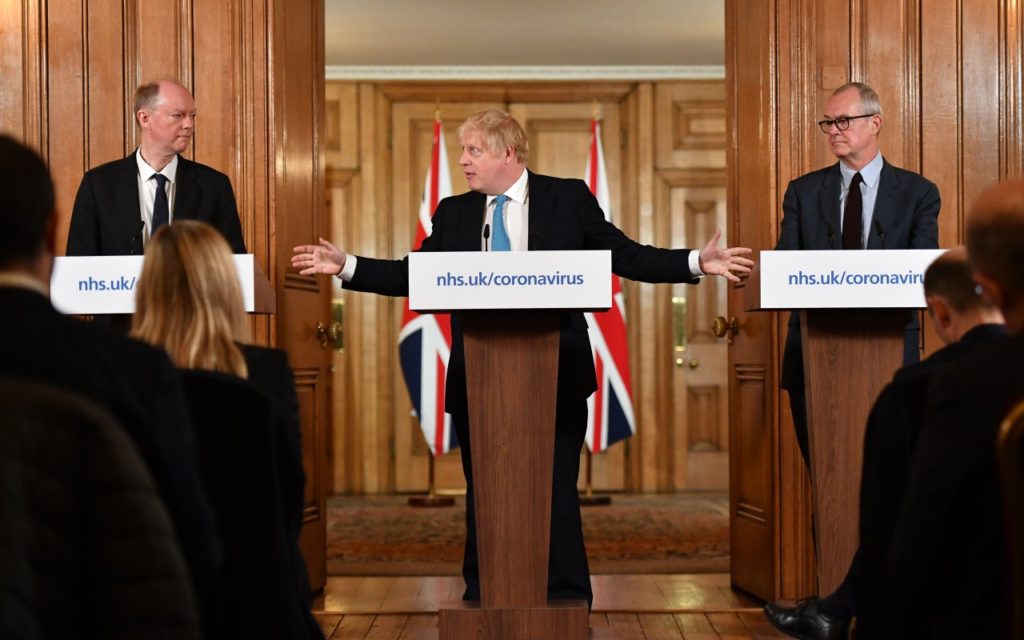
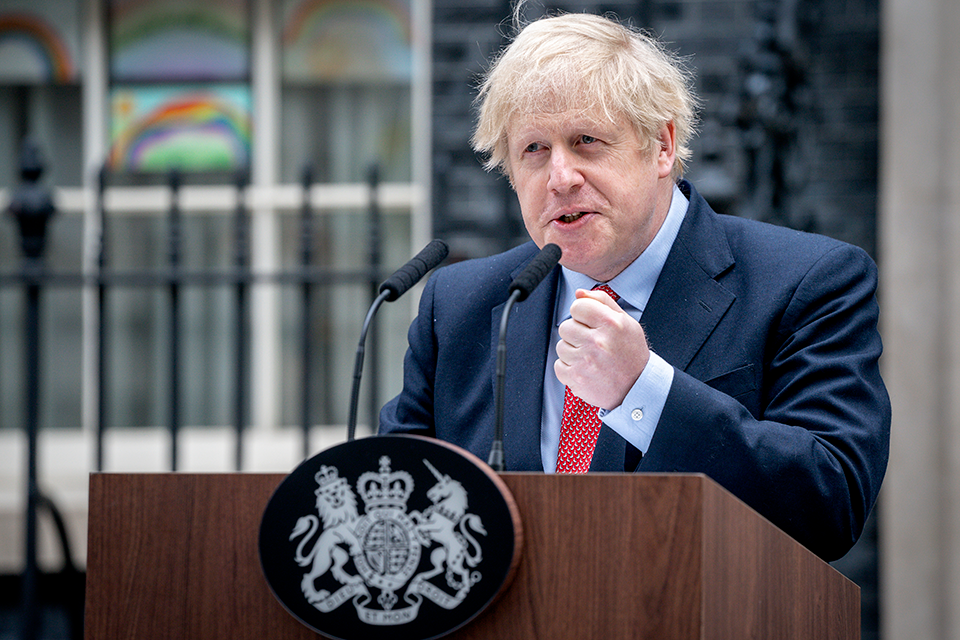
But many found Prime Minister Boris Johnson’s Downing Street back-to-work address nauseating. Not least because he made almost no mention of the astonishing suffering and loss of life, or the cloud of grief descending upon our land, talking instead of the UK’s “apparent success” in combating the “invisible mugger” that is Coronavirus.

How does a man who has presided over the calamity of our lifetimes dare to stand in front of us and talk of “success”? A man whose inaction and hubris in January and February – not to mention those fateful, shameful eleven days in March – was tantamount to welcoming the Covid-19 “mugger” into the UK with open arms and a free (blue) passport. With the country on course to have one of the worst per capita death tolls in the world; with 45,000 or so lives already lost; with families grieving up and down the land and unable even to attend funerals; with 5,000 new cases a week, what on earth was he thinking?

The answer is there in plain sight – in his relentless insistence on “protecting the NHS”. (Rich, I know, coming from the Tories who have choked the NHS for a decade, frozen nurses’ pay, demonized its European staff, and who even now fail it on a daily basis with their incapacity to deliver basic equipment – and yet they have the temerity to clap on Thursdays and call it “our NHS” … But bear with me. The sheer unlikelihood of the Tories suddenly falling in love with state provision is the clue to understanding Johnson’s evident satisfaction with the current state of affairs.)

Remember Johnson’s “powered by love” speech after coming out of hospital, on 12th April? He waxed lyrical about the NHS, his nurses Jenny and Luis, and about the spirit of the British people, whose lockdown struggle was elevated – by sheer power of grandiose rhetoric – from fretting at home to a heroic defence of the nation and its health service, conjuring up images of brave Brits linking arms around the perimeters of our hospitals, ready to repel for Queen and country.

“We are making progress in this national battle because the British public formed a human shield around this country’s greatest national asset: our National Health Service.”         (12 April 2020)

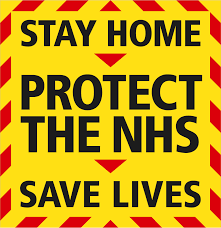
This idea of the public as some sort of people’s army championing the NHS, though vividly painted here, wasn’t new. It’s been there in our daily diet for some time now. We’ve been exhorted not, as might have been expected, simply to stay at home and (thereby) save lives, but to stay at home, protect the NHS and save lives.

What work is this extra clause doing? It doesn’t change the overall instruction. It doesn’t give us anything more to do or not do. Our lockdown cabin fever stays the same. As instructions go, “Protect the NHS” is a weird one. Its insertion feels like a “tell”. And the way it sits awkwardly in the middle like that, it sometimes feels like the ‘protecting the NHS’ part is more important than the ‘saving lives’ part. Sometimes the graphics reflect that feeling, too.

Of course, the notion of us protecting the NHS is the wrong way round. Notwithstanding our duty – shamefully neglected – to protect its staff, the NHS is there to protect us. That’s its purpose. Our “greatest national asset” is not the NHS, it is us, the people. The clue is in the name: it’s a service. Our service. To protect us and care for us. But Johnson congratulates us for forming a human shield around it, as if our job were to sacrifice our lives for it, rather than turning to it for salvation in our gritless, gutless hour of need.

Of course, the NHS can only protect us if we don’t overwhelm it. There’s no doubt that we have all had to play our part in flattening the curve, otherwise the NHS wouldn’t have been able to cope. Flattening the curve has meant we’ve delivered patients at a steadier pace, and nurses like Johnson’s Jenny and Luis have, just, been able to manage. Fewer people will have died than would have been the case if the patients had all presented in one big wave. We get that. We know why we’ve stayed at home.

But our core interest is in saving lives. For us, the NHS is a means to that end, not an end in itself. In contrast, Johnson’s language reveals, time and again, that his priority is to be able to say that the NHS has coped, no matter how many people have died. Saving lives is secondary. Saving lives is in smaller print. When he describes the NHS as “the beating heart of this country”, it’s as if he has substituted the NHS for the people; as if he has forgotten the actual beating hearts of the country. And indeed the ones which have stopped beating.

“We will win because our NHS is the beating heart of this country… It is unconquerable.”      (12 April 2020)

This warped love for the NHS makes sense if his greatest fear has not, in fact, been a death toll the size of the entire WWII Blitz. It makes sense if, on the contrary, his greatest fear has been the dire imagery of an NHS in collapse. Large numbers of patients dying unattended in corridors, or in ambulances queueing outside. Medics despairing. Emergency services unable to respond. All manner of collateral chaos. The inevitable media reports would be beyond his control, and his premiership would likely be over. The images would endure for generations.

That collapse has, somehow, and mercifully, been avoided. The unfolding care home disaster, which has involved the exporting of demise to disparate locations, far from the hospital front lines, may be part of the explanation. And shattered, lethally under-equipped NHS staff might say that calamity has been far closer than the public realises.

Certainly the families of those staff who have lost their lives will find little comfort in the idea of the NHS having been spared complete collapse. Their worlds have been destroyed. The same goes for the families of all of the 45,000+ victims. There is no consolation for them.

But for Johnson, the difference between near-breakdown and total breakdown is all the difference in the world. The optics of a visibly collapsed NHS would likely have been terminal. An ocean of kryptonite from which, this time, there could be no heroic return. The unconquerable would have been conquered. But the invisible deaths of coronavirus, in which loved ones disappear into an ambulance never to be seen again, seem not, yet, to be damaging him.

Small wonder, then, that in his back-to-work address, he saw no problem in stepping over the invisible dead, and talking instead about our “progress” and our “apparent success”. Because, from where he’s standing, a vital mission has indeed been accomplished. The mission, at all costs, to prevent the NHS from appearing to be in meltdown. The mission to save face. The mission, ultimately, to save Boris.

“We defied so many predictions. We did not run out of ventilators or ICU beds. We did not allow our NHS to collapse.”      (27 April 2020)

Johnson and his sycophants have not suddenly fallen in love with the notion of state health care. They don’t profess to love the NHS because it saves you and me. They love it because – for as long as it appears, however narrowly, to be coping – the NHS saves them.

“… if we could stop our NHS from being overwhelmed, then we could not be beaten… ”       (12 April 2020)

Our “human shield” around the NHS is really a shield around the incompetence and arrogance of a Prime Minister who was repeatedly warned there was a “mugger” on the path ahead, but blithely took us that way anyway.

Since then, he has sought to mug us, by hijacking our appreciation for the NHS and twisting it with weasel word-play into a truly remarkable political bomb-shelter. So far, he must be thinking, “apparent success.”

Thank you for reading. Please help me reach more like-minded people, using the sharing buttons below.

That Covid Bloke

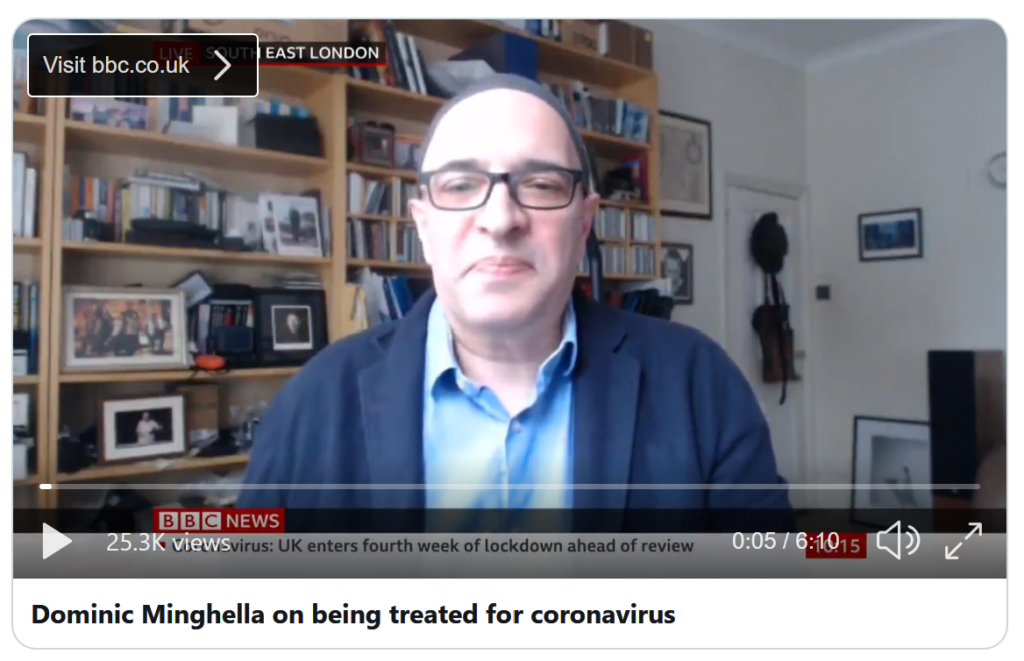
For a little while – perhaps because I was an early case to come out of hospital – I became “that Covid bloke”, asked to share my experience in print, on radio and on TV.  I was happy to do it, but I’m not sure how long I want to be that (ultimately) happy “good news” story.

Because, as we all know, almost nothing about this Covid calamity is good news. As I recover, my elation at being alive is developing into something else. Determination. And fury.

Here below (image clicks through to the BBC’s twitter) is me talking to Victoria Derbyshire recently about my hospital experience – and, although she invites me to talk about my anger, I don’t really take it. More fool me. I should have leapt at the chance. 


PS – I articulate some of that fury for you here.  No extra charge!

Eleven Days In March

This article also appears in The New Statesman.

Ask a scientist or a mathematician, as I have done, what those eleven fateful days in March cost us.

You won’t like the answer.

It has kept me up, my mind spinning like it does when I’ve had too much caffeine, half the night.

The eleven days in question are 12th – 23rd March. Eleven days in which the government decided to give up with contact tracing and do, well, nothing. Mass gatherings were still allowed (because “science”). Concerts and racing and Champions’ League football. Pubs. Public transport. Everything.  The over-70s, it must be conceded, were advised to avoid cruises.

Medics in Italy screamed – Do something! Don’t make our mistakes! Are you blind? Look at what happens if you leave it too late!

In those eleven days, our government decided there was nothing to be done. We wrestled open-mouthed with the ideas of “taking it on the chin” and “letting it pass through the community” and “herd immunity”.

Then the government realised that this “strategy” might produce upwards of 250,000 deaths in the UK. It woke up. And it locked down. Not very firmly, it has to be said, compared with other European countries. But still.

The eleven days during which our government decided there was nothing it could do include the days during which I was asymptomatic with CV-19. I’m confident I picked up my infection on a packed train from Northallerton to London, on March 8th. I had no idea. In the following few days, of maximum infectiousness, I went to King’s College Hospital for a routine ultrasound. A medic there reckoned all the fuss and fear was unnecessary – It’s just like ‘flu, isn’t it? (Remember those days? It’s just like ‘flu!)

I went to shops and cafes and took my kids to school. On 12th March, with our government saying there was nothing to be done and abandoning us to the virus, I tried to buy hand sanitiser, but it was all gone. I went to the Post Office to pay £3 for underpayment of postage on a mystery item, which turned out to be a small tin of Love Heart sweets, a late present for my daughter’s birthday. I passed my credit card to the post office worker to show my ID. At the pharmacy I signed the back of my prescription using a communal pen tied to the till with string. I went to our tiny, closely-aisled Tesco’s. Etc, etc. All the time, I was anxious about catching this invisible virus which was already wreaking such havoc in Italy. I had no idea that my selfish fears were pointless. I had already caught it. I wasn’t catching it. I was spreading it.

The very thought of it is chastening. I probably spread my infection to others using the post office, the pen at the pharmacy, the keypad at the little Tesco’s. I made them ill. I had no idea, of course. No symptoms at all. But I may have killed people. Let’s be honest, almost certainly I infected people, who infected others, who infected still more… and “my” viral spreading will have cost some people their lives. Some families their loved ones.

It doesn’t bear thinking about. It makes me sick. But I had no way of knowing. These were the early days of Covid in the UK. It was still a virus that was “over there” and not here. It was still a virus for older people, not healthy-ish guys in their fifties. Towards the end of those eleven days, on March 19th or 20th, I was starting to realise I had a problem. On the day the government woke up and finally put the UK into lockdown, it was already too late for me. I was gasping for breath and (foolishly) resisting advice to go to hospital. The next day I was in an ambulance, back to King’s. A hospital now completely transformed in the interim since my scan visit. Eerily quiet, and apparently entirely given over to Covid. There seemed to be a massive dissonance between the government’s blasé, laissez-faire public stance, and the complete reorganization of an entire London teaching hospital, impressively ready for the likes of me to start arriving in great numbers. The hospitals knew. They did something. The government must also have known. They did nothing.

Back to those mathematicians and scientists. What did those eleven days of our government standing frozen in the headlights cost us? How many cases? How many lives lost? If I am guilty of spreading the deadly virus, however unwittingly, how about the government? They knew people like me would be going about their business without symptoms, and spreading the virus. They decided to do nothing. How many cases did they, with this knowledge, allow to happen in those eleven days? How many lives did they, with this knowledge, allow to be lost?

The folks who understand maths warn me of all manner of caveats and assumptions. Sure. It’s going to be a highly inexact science. But roughly? Ten per cent? Twenty? Fifty?

No. The answer is somewhere around two thirds. Maybe more. Maybe a lot more. Basically most of them. Basically most of the cases. Basically most of the deaths. Most of the horrible sickness and dread. Most of the loved ones lost.*

Incredible, isn’t it? Thousands of people suffering or dying or grieving because of those eleven arrogant, stupid, murderous days.

Of course we’d have had cases, come what may. My own included. But, had there been a lockdown, I wouldn’t have been out and about and unknowingly spreading. That’s the point.

So now what? First: be clear about the truth. Hold onto it. If anger ensues – and how could it not? – feel the anger. Direct the blame. Murderous, criminal decisions must be seen for what they are. Hold those responsible to account. If anyone tells you not to politicise, or that “now is not the time”, or that you are not an expert, so your opinion is not valid, ignore them. They are gaslighting you. This happened. It really happened. Retain your clarity. Focus your rage. Articulate it.

But of course, we can’t go back. So second: learn from this truth. Learn that our government is incompetent and dishonest. Learn that our government CAN cost us and our loved ones our lives. Demand, then, honesty. Clarity. And – now, right now – demand transparency about the plan (if there is one) for the future, for moving out of lock down. Insist, if and when that plan materialises, that it makes sense. Insist that it does not just take us back to where we were in those eleven days, waving a white flag at the virus and hoping it will be kind to us. Do not allow patently absurd policies to be defended by debate-stifling claims that they are based on “the” science. That can’t wash any more.

Because those eleven days show us that our government has form. Left to its own bewildering devices, it makes terrible decisions. Even now, it fails, daily, to deliver on its promises to the NHS. We’re approaching peak and we don’t have the tests. We don’t have the masks, we don’t have the gloves and we don’t have the gowns. The Treasury talks a big talk on the economy, but only a tiny fraction of its advertised bailout measures have actually been delivered. Parliament is not sitting and the daily Downing Street briefings have become a platform not for the dissemination of unadorned public health information, but for ministers to defend appalling records and then bat away the Skype-garbled questions of journalists, as if this were just everyday politics, and not the crisis – literally – of our lives..

So it is up to us all to challenge, to question, to argue, all day long. It is not “unhelpful” or unpatriotic or whatever else the gaslighters will want us to feel. It is our right. It is our duty. Our lives, our friends’ lives, our families’ lives may very well depend on it.


Thank you for the extraordinary response to this article (combined readership of over one million). Please help me reach more like-minded people, using the sharing buttons below.

You might also like: my account of being an ‘early adopter’ of Covid-19.

*I’m not sharing the calculations. They’re so rough. I bet there will be researchers somewhere whose curiosity will have had them working on some harder numbers, based on data and good modelling. I guess it could take months for the data to be solid enough.  Meanwhile, I encourage them to be brave and share their initial findings.